Chapter 6: Why the Rules Are Legalistic, and How to Read Them
IN BRIEF · The Rules are drafted to be parsed in court, so they must be parsed the same way on the bridge. Four families of words carry the load: qualifiers grading how hard a duty binds, precedence words deciding which rule wins, deeming words settling doubtful facts in the safe direction, and savings words stopping duties quietly disappearing. Read like a lawyer to know exactly what you owe, then act like a seaman: early, bold and legible.
The COLREGs do not read like instructions. They read like a contract, full of qualifiers and carefully graded obligations, words like “shall,” “so far as possible,” “notwithstanding” and “shall be deemed to.” To an officer who only wants to know what to do when a ship is bearing down on him, this can look like lawyers’ clutter laid over plain seamanship. It is not. Every one of those words does real work, and the difference between two of them can be the difference between being found at fault and being found blameless. This chapter is about reading the Rules the way they are written. That means reading them with a lawyer’s attention to the exact force of each word, so that you know precisely what you are obliged to do and precisely what you are not. The discipline the chapter builds toward is simple to state and hard to hold: read like a lawyer, act like a seaman.
Why the Rules are written this way at all
To understand the language you have to understand the two jobs the text is doing at once. The first is the obvious one. The Rules tell mariners how to behave so as not to collide. The second is the one that shapes the wording. The Rules are also the document a court reaches for after a collision has happened. They are a treaty, which is to say a formal agreement between states that carries the force of law once each state enacts it, as Chapter 3 set out. And they are at the same time the yardstick against which every collision is later judged. When two ships collide, the question that follows is not “was everyone doing their best” but “who departed from the Rules, and by how much,” and the answer decides who pays.
This is not a remote or theoretical use of the text. Rule 2 is the legal basis for action against a vessel’s owner and master, with the case tried in the courts of the country concerned, and on the high seas under the appropriate national shipping act (BR45 Vol 4, para 1013). The standard commentary every officer is pointed to, Cockcroft and Lameijer, exists precisely because the Rules have been argued over and over in court. The book is, in its own words, a comment on the Rules particularly on how they have been interpreted by the courts of the United Kingdom and other countries, built around extracts from the judgments that remain relevant to the current text (Cockcroft & Lameijer, 7th ed, preface). Courts do not find a vessel simply “at fault” in the round. They apportion blame in precise percentages by reference to which rules each vessel broke and how seriously, as the cases threaded through this guide show. The text is drafted for that proceeding. Its precision is the instrument allocating responsibility in advance, not decoration, so that when the matter reaches a courtroom the answer is already written into the words.
That has a direct consequence for how you read. Because the wording is built to be parsed in a court, it must be parsed the same way on the bridge. A rule that binds you absolutely and a rule that binds you only “so far as practicable” impose genuinely different duties. Reading past that difference means misjudging what you actually owe and what you can actually be blamed for. The legalism is therefore the part of the Rules that tells the officer, with more precision than plain language could, exactly where his obligations begin and end, not an obstacle between the officer and the seamanship. The rest of this chapter takes the wording apart along the lines the drafters built into it: the graded hierarchy of how strongly a rule binds, the words that make one rule override another, the words that create presumptions you cannot argue your way out of, and the words that preserve your liability no matter what. Each is a tool for reading, and together they are how an officer turns a dense legal text into a clear account of his own duty.
The obligation hierarchy: how hard does the rule bind?
The first and most useful thing the legal wording encodes is how strongly an obligation binds. Not every duty in the Rules is absolute, and the drafters graded them deliberately. They used a small vocabulary of qualifying phrases to say, in effect, “you must do this no matter what,” or “you must do this unless it is genuinely impossible,” or “you must do this so far as it is reasonable to.” Learning to read that grade is half of reading the Rules, because two obligations that look similar on the page can bind you very differently, and the difference is carried entirely by a few words tucked into the sentence. A qualifier, in this sense, is simply a phrase that loosens an obligation in a defined way.
At the top of the hierarchy is the unqualified “shall.” In legal drafting “shall” is the mandatory operator. It imposes a command, not advice, and it leaves no discretion, which is to say no room for the officer to decide the duty does not apply to him. Most of the obligations in the COLREGs are written this way, as a bare “shall” with no softening, and where they are, there is simply no latitude. The Rules almost never use “should.” They use “shall.” The drafters chose the mandatory word, and an officer who reads a “shall” as if it meant “ought to, conditions permitting” has already misread his duty.
Below the absolute “shall” sit the qualified forms, and the two that matter most are often confused because they sound alike: “so far as possible” and “so far as practicable.” They are not the same, and the difference between them is the clearest single example of why the wording has to be read precisely. “So far as possible” is the stronger of the two. It loosens the obligation only by the limit of what can actually be done. A vessel escapes it only by showing that compliance was genuinely impossible, and mere difficulty, expense or inconvenience will not do. Rule 16 is the model: every give-way vessel “shall, so far as possible, take early and substantial action to keep well clear” (MISCPUB 0127, Rule 16), and Cockcroft reads this as a strong duty to take early avoiding action that yields only to real impossibility (Cockcroft & Lameijer, 7th ed, comment on Rule 16). “So far as practicable,” by contrast, brings in a test of reasonableness. Something can be entirely possible and still not practicable, because the cost or the risk of doing it outweighs the benefit, and the practicable standard allows for that. It is the more forgiving qualifier. It governs much of Rule 10, where a vessel “shall, so far as practicable, avoid crossing traffic lanes” but may cross if obliged to (MISCPUB 0127, Rule 10(c)), and Rule 9, where a sailing vessel keeps to the starboard side of a narrow channel “so far as practicable,” with Cockcroft noting openly that there are waters where it is simply not practicable to do so (Cockcroft & Lameijer, 7th ed, comment on Rules 9 and 10). The test for “possible” is “could it be done at all.” The test for “practicable” is “was it reasonable to do.” Reading one as the other either invents an excuse the rule never gave you or denies you a latitude the rule did.
The third qualifier works differently again, and is the most often misunderstood. “If the circumstances of the case admit” does not loosen whether you are bound. It conditions how you must perform the duty in the particular situation. The underlying obligation stays absolute, and only the manner of discharging it adapts. Rule 15 shows the structure plainly: the give-way vessel in a crossing “shall keep out of the way,” which is unqualified and absolute, “and shall, if the circumstances of the case admit, avoid crossing ahead of the other vessel” (MISCPUB 0127, Rule 15). The duty to keep out of the way never bends. What “if the circumstances of the case admit” qualifies is only the preferred method, passing astern. Where that method is not open, the duty to keep clear remains and must be met another way. Cockcroft explains the phrase as incorporated precisely to provide for the particular situations in which the ordinary manner of compliance is not available (Cockcroft & Lameijer, 7th ed, comment on Rule 8; and see comment on Rule 18(d)).
PRACTICAL NOTE: the obligation adapts, it does not disappear
The trap in “if the circumstances of the case admit” is to read it as a let-off. Take a give-way vessel in restricted water with another on her starboard bow, unable to turn to starboard to pass astern. She does not get a free pass on keeping clear. Her duty to keep out of the way under Rule 15 is absolute. Only her means of doing it have narrowed, so she keeps clear another way, for instance by taking off speed rather than altering course. When you meet “if the circumstances of the case admit,” ask not “am I excused” but “the duty stands, so by what other means do I meet it.”
Held together, these phrases tell you how hard each obligation binds: absolute under a bare “shall,” near-absolute under “so far as possible,” reasonableness-bounded under “so far as practicable,” and method-conditioned but still binding under “if the circumstances of the case admit.” None of this is visible to an officer reading for the gist, and all of it is visible to one reading for the words. The next sections turn from how hard a rule binds to which rule wins when two of them speak at once, and to the words that decide a question before you can argue it.
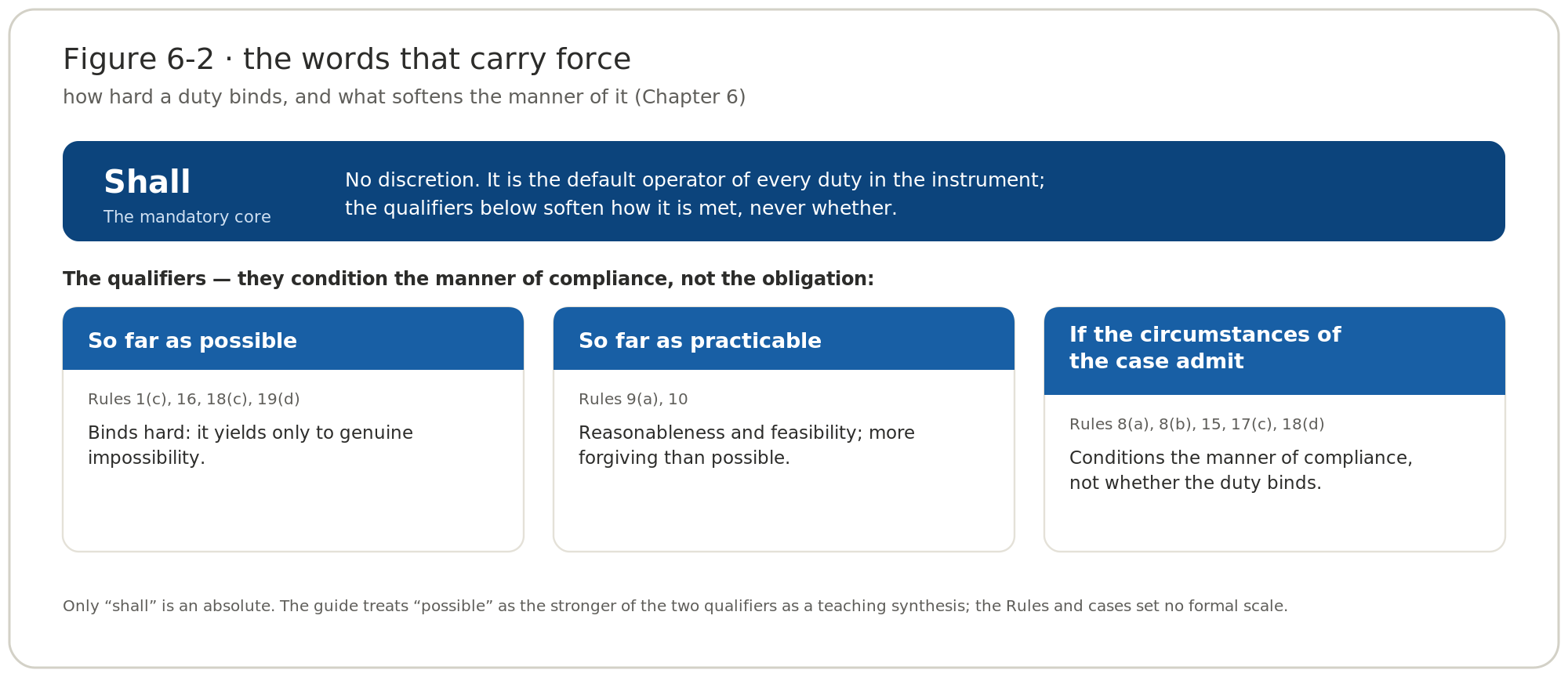
Figure 6-2. The words that carry force. The mandatory “shall” and the three qualifiers beneath it, with the Rules each appears in: the qualifiers condition the manner of compliance, never whether the duty binds.
Override and precedence: which rule wins
Chapters 5 and 8 made the point that more than one rule is usually in play at once, and that a few rules cut clean across the others. When two rules speak to the same situation, something has to decide which one governs, and the text decides it with a small set of precedence words. An officer has to be able to read them, because mistaking which rule wins is mistaking what he must do.
The most powerful of them is “notwithstanding.” It is an old legal word that means “despite,” or “regardless of anything said to the contrary.” When a provision begins “notwithstanding X,” it is telling you that it takes effect even where X would point the other way. The Rules use it to give one rule outright supremacy over a whole block of others. Rule 13 is the case to learn it on. It opens, “Notwithstanding anything contained in the Rules of Part B, Sections I and II, any vessel overtaking any other shall keep out of the way of the vessel being overtaken” (MISCPUB 0127, Rule 13(a)). That single word lifts the overtaking duty above every other steering and sailing rule in those two sections, and BR45 states the consequence plainly: Rule 13 overrides everything in Part B Sections I and II (BR45 Vol 4, para 1006a).
What “notwithstanding” buys is certainty for the vessel being overtaken. Because of it, the overtaking vessel keeps clear no matter what any other rule might otherwise give her. She keeps clear even if she belongs to a class that the order of responsibility in Rule 18 would normally privilege. And she keeps clear even if, as she draws up and out to one side, the bearing begins to look like a crossing, because Rule 13(d) has already shut that escape (Chapter 8). The word is the instrument resolving a conflict between its own rules by declaring one of them supreme, and it is the reason an overtaking vessel can never argue her way out of the duty to keep clear.
The converse device sits at the head of Rule 18. That rule sets the order of responsibility between different classes of vessel, power-driven giving way to sailing, sailing to fishing, and so on. But it opens with a condition: “Except where Rules 9, 10, and 13 otherwise require” (MISCPUB 0127, Rule 18). This is the mirror image of “notwithstanding.” Instead of one rule claiming supremacy, Rule 18 stands aside wherever the narrow-channel rule, the traffic-separation rule, or the overtaking rule requires something different. The pecking order it sets is real, but it is not absolute. It yields, by its own opening words, to those three rules.
Put the two devices on a single encounter and watch them settle it. Imagine a vessel engaged in fishing coming up on a power-driven vessel from astern to overtake her. The instinct, drilled from Rule 18, is that a power-driven vessel keeps out of the way of a vessel engaged in fishing (MISCPUB 0127, Rule 18(a)(iii)), so surely the power-driven vessel gives way. But the fishing vessel is overtaking. Rule 13’s “notwithstanding” lifts the overtaking duty above the Rule 18 order, and Rule 18’s own “except where … 13 otherwise require” hands the question to Rule 13 in any case. Both phrases point the same way, and the result is clean: the fishing vessel, as the overtaking vessel, keeps clear, even though she is a class Rule 18 would otherwise have privileged. Two small precedence words, read for exactly what they do, resolve a conflict that the bare pecking order would have got wrong.
This is why the precedence words deserve as much attention as the obligations themselves. They are the instrument’s own way of signalling which rule to obey when several provisions apply at once. Reading them is how an officer finds the governing rule under pressure instead of guessing, and it is the concrete reason this guide treats the interaction of the Rules as first-class content rather than a footnote. The next section turns to a different kind of word: not the words that decide which rule wins, but the words that settle a question of fact before you are permitted to argue about it.
Deeming and presumption: the words that decide a fact for you
The qualifiers grade how hard a rule binds, and the precedence words decide which rule wins. A third family does something more aggressive than either. It settles a question of fact before you are allowed to argue about it. These are the deeming words, and they are among the most important in the instrument, because they operate at the exact moment officers are most tempted to hesitate.
The key phrase is “shall be deemed to.” To “deem” something, in legal language, is to treat it as true by force of the rule, whether or not it is literally or obviously so. A deeming provision takes an observable condition and converts it into a settled legal status, so that once the condition is met, the status follows as a matter of the rule and not of anyone’s opinion. The Rules use this to take the argument out of classification. A vessel “shall be deemed to be overtaking” when she is coming up from more than 22.5 degrees abaft the other’s beam (MISCPUB 0127, Rule 13(b)). A head-on situation “shall be deemed to exist” when a vessel sees the other ahead or nearly ahead with the masthead lights in a line and/or both sidelights (MISCPUB 0127, Rule 14(b)). And vessels “shall be deemed to be in sight of one another only when one can be observed visually from the other” (MISCPUB 0127, Rule 3(k)). The effect is that you do not get to contest the label. An officer who was coming up from abaft the beam cannot afterwards argue that he was not “really” overtaking. And a vessel holding a contact on radar in fog is not “in sight” of her, however sharply she shows on the screen, because the rule has deemed the question closed. Reading “deemed” tells you that the condition stated is the whole of the test, and that meeting it decides the matter.
The same machinery is turned on uncertainty itself, and this is the part that matters most on watch. A presumption is simply a starting position the law adopts unless and until something displaces it, and the Rules build in presumptions that always fall on the side of safety. Where you are unsure whether risk of collision exists, the rule does not leave you to weigh it: “if there is any doubt such risk shall be deemed to exist” (MISCPUB 0127, Rule 7(a)). Where you are unsure whether you are overtaking, “she shall assume that this is the case and act accordingly” (MISCPUB 0127, Rule 13(c)). Where you are unsure whether a meeting is head-on, “she shall assume that it does exist and act accordingly” (MISCPUB 0127, Rule 14(c)). Each of these resolves the doubt against the convenient reading and toward the cautious one. You are not given the benefit of the doubt. The other vessel is.
This is a deliberate piece of design, and seeing why it is there is half of reading it correctly. The moments these words govern, “is this risk of collision,” “is this a head-on,” “am I overtaking,” are precisely the moments where a watchkeeper is tempted to wait for certainty. And waiting for certainty is what kills people, because certainty usually arrives too late to act on. So the text refuses to let the question stay open. It pre-decides it, in the safe direction, and removes hesitation as an option. The practical consequence is blunt: “I wasn’t sure” is not a defence, because the rule has already told you what to do when you are not sure. If a contact’s bearing will not settle and you cannot be confident it is drawing clear, Rule 7(a) has deemed risk of collision to exist, and you act on that, rather than holding on in the hope that the next few minutes will resolve it in your favour.
Together, the deeming and presumption words are the instrument taking judgement away at the one place judgement is least reliable and most dangerous: the classification of a situation under uncertainty. They are not loopholes and they are not technicalities. They are the Rules deciding, in advance and on your behalf, the questions you would otherwise be tempted to get wrong.
Savings and burden: the words that stop a duty disappearing
The last family of words does not grade an obligation, decide which rule wins, or settle a fact. It makes sure that obligations do not quietly vanish, either by being read out of existence or by one rule being treated as cancelling another. Lawyers call the first of these a savings clause, a provision whose whole job is to preserve something so that nothing else in the instrument can be taken to have removed it. The COLREGs contain the most important savings clause in maritime law, and it is Rule 2(a).
Rule 2(a) provides that “nothing in these Rules shall exonerate any vessel, or the owner, master or crew thereof, from the consequences of any neglect to comply with these Rules or of the neglect of any precaution which may be required by the ordinary practice of seamen, or by the special circumstances of the case” (MISCPUB 0127, Rule 2(a)). To “exonerate” is to clear of blame, and the clause says that nothing in the Rules can do that for you. Its force is to shut off the most tempting defence of all, the argument that “no rule told me not to,” or “I complied with the letter, so I cannot be at fault.” You can comply with every applicable rule to the word and still be liable, because Rule 2(a) preserves your responsibility for the seamanship the Rules assume but do not spell out. This is the legal basis of the point Chapter 10 builds at length: compliance is a floor, not a ceiling, and Rule 2(a) is the wording that enforces it.
The second device is the negative phrase “does not relieve,” or its passive twin “is not relieved of.” To “relieve” a vessel of an obligation is to discharge her from it, to let it fall away. The Rules repeatedly use the negative to stop exactly that from happening when one rule might be read as overtaking another. A vessel using a traffic separation scheme is not relieved of her obligations under any other rule (MISCPUB 0127, Rule 10(a)). The narrow-channel overtaking signals do not relieve the overtaking vessel of her duty under Rule 13 (MISCPUB 0127, Rule 9(e)(ii)). The stand-on vessel’s permission to act does not relieve the give-way vessel of her own duty to keep out of the way (MISCPUB 0127, Rule 17(d)). A vessel required not to impede is not relieved of that duty when risk of collision develops (MISCPUB 0127, Rule 8(f)(ii)). And a later change of bearing does not relieve the overtaking vessel of her duty to keep clear until finally past and clear (MISCPUB 0127, Rule 13(d)). Each of these closes a door that a careless reader might otherwise walk through.
The principle underneath the whole family is that the obligations of the Rules are cumulative, not substitutive. They stack. Meeting your duty under one rule does not discharge your duty under another. A permission granted by one rule does not cancel an obligation imposed by a second. And beneath all of them the general duty of good seamanship preserved by Rule 2(a) never lifts at all. These words exist to defend the instrument against the lawyer’s move of treating a single favourable rule as a complete answer. Read them, and you understand that you are never carrying just one obligation at a time. You are carrying every rule that applies, at once, with Rule 2 underneath the lot.
The fine print: distinctions, and distinctions without a difference
The families of words so far have been the obvious machinery. Beneath them the Rules vary their wording in smaller ways, near-identical phrases that differ by a single word or a preposition. A careful reader has to make a judgement each time: is this variation doing work, or is it just the drafters writing the same idea two ways? Both happen. Some small differences are real and must be read for. Others are distinctions without a difference, where the wording changes but nothing in the Rules or the cases makes the meaning change. Telling one from the other, and erring toward caution when unsure, is the finest level of reading the Rules.
Start with the differences that are real. The Rules use four separate phrases for getting out of another vessel’s path, and they are not synonyms. “Keep out of the way,” in Rules 12 to 18, names the give-way role itself. “Keep well clear,” in Rule 16, is a stronger standard for the result of that role, the difference the translation of Rule 16 below draws out. “Do not impede,” in Rules 9 and 10, is a different kind of duty altogether, the upstream obligation to leave enough room that a close-quarters situation never forms, which Rule 8(f) bridges to the encounter rules and which Cockcroft treats at length as a distinct requirement first fixed by the 1987 guidance on the words “not to impede” (Cockcroft & Lameijer, 7th ed, comment on Rule 8). And “keep clear,” used of a separation line in Rule 10(b)(ii), is the plainest of the four. Read “do not impede” as “give way” and you have mistaken when the duty bites. Read “keep well clear” as the bare “keep out of the way” and you have understated the standard the result must reach.
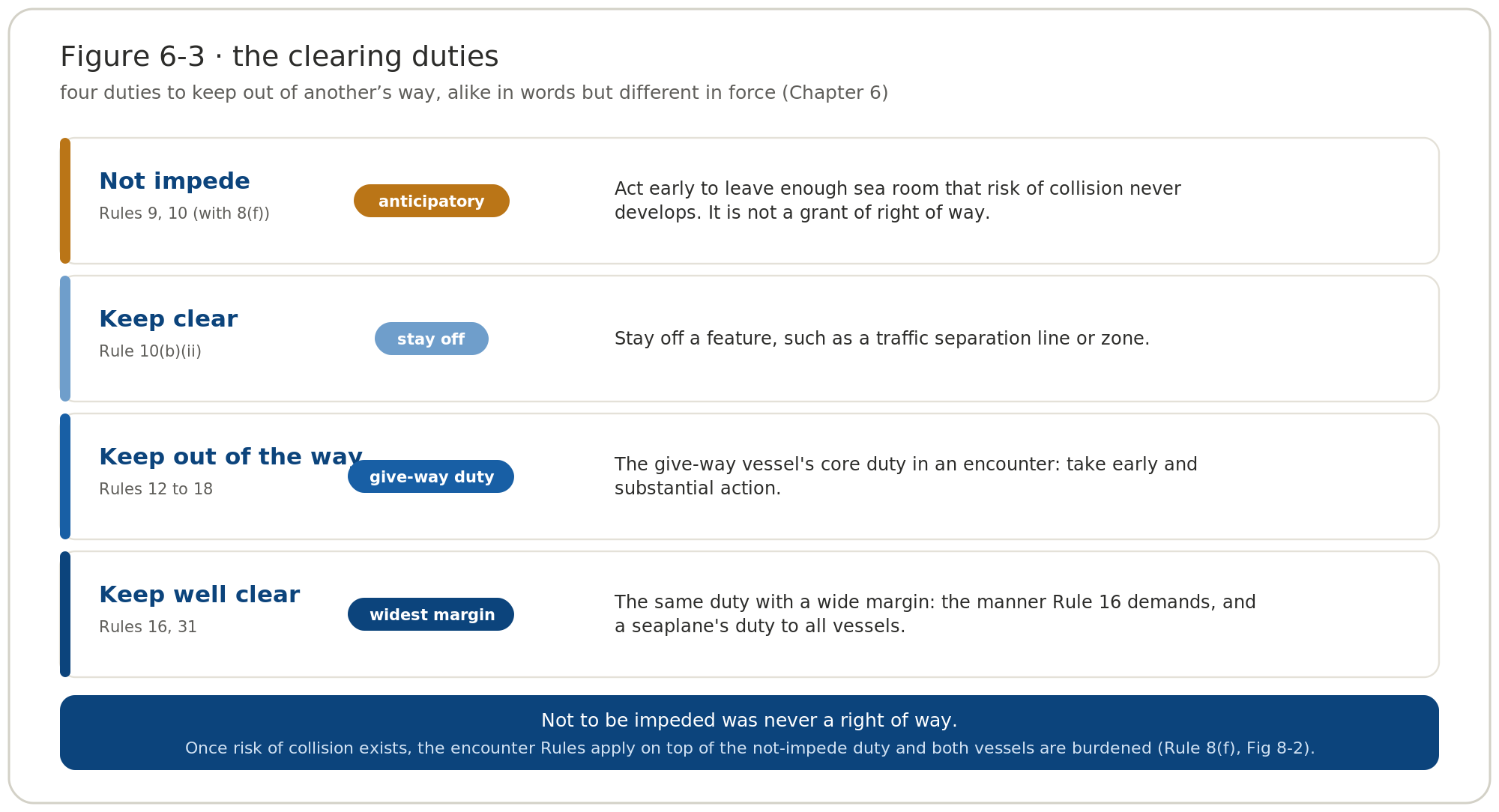
Figure 6-3. The clearing duties. Four duties to keep out of another’s way, alike in words but different in force: not-impede is anticipatory and was never a right of way; once risk of collision exists the encounter Rules apply on top of it and both vessels are burdened (Rule 8(f), Figure 8-2).
A second real difference is the smallest word carrying the most weight: “may” against “shall.” In Rule 17 the stand-on vessel “may” take action by her own manoeuvre when the give-way vessel is not acting (17(a)(ii)), but “shall” take action when collision can no longer be avoided by the give-way vessel alone (17(b)). One word is permission, the other command, and the move between them is the turning point between the third and fourth stages of an encounter (Chapter 8). Wherever “may” and “shall” sit close together in the text, the difference is deliberate and does real work.
A third is a gradation the Rules build without ever labelling it. They ask for three different intensities of care: “particular alertness and caution” approaching a blind bend in a narrow channel (Rule 9(f)), “particular caution” near the end of a traffic separation scheme (Rule 10(f)) and for a vessel constrained by her draught (Rule 18(d)(ii)), and “extreme caution” in restricted visibility when a close-quarters situation cannot be avoided (Rule 19(e)). Whether the drafters intended a precise three-rung ladder is not certain, and no case turns the three into fixed steps, but the escalation is plain on the page, and the strongest demand, “extreme caution,” is reserved for the blindest situation, fog. Read the variation as the warning it looks like.
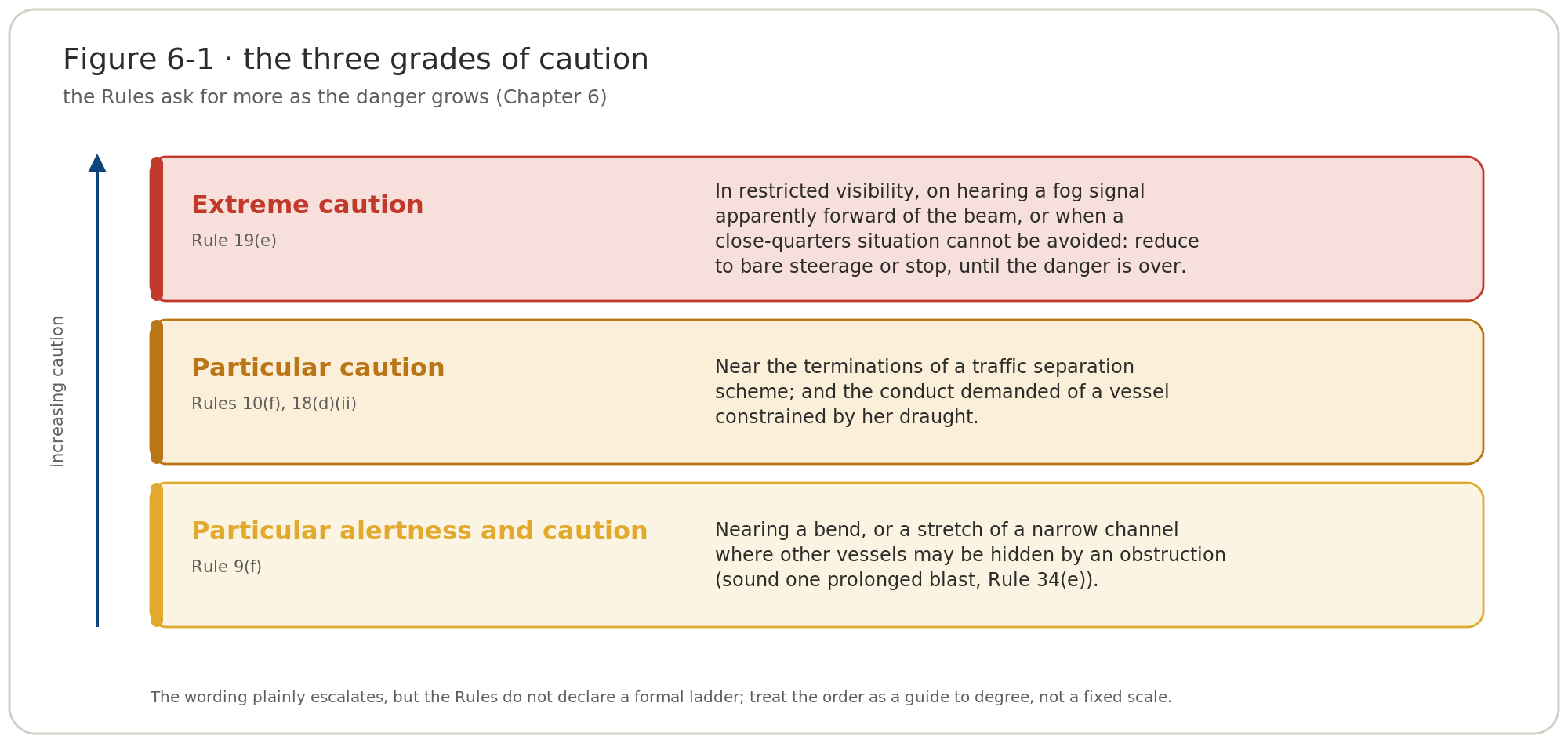
Figure 6-1. The three grades of caution. The Rules ask for more as the danger grows, from “particular alertness and caution” at a blind bend to “extreme caution” in fog. The wording plainly escalates, but the Rules declare no formal ladder; treat the order as a guide to degree, not a fixed scale.
Now the distinctions that are probably not distinctions at all, because honesty about these matters as much as precision about the others. Rule 5 requires a look-out by all available means “appropriate in the prevailing circumstances,” while Rule 7 requires all available means “appropriate to the prevailing circumstances.” The construction is identical and only the preposition changes, and nothing in the Rules or in Cockcroft makes “in” mean anything different from “to.” It is almost certainly drafting variation, not a distinction to act on. The same goes for “ample time” in Rule 8(a) and “good time” in Rule 8(c): both mean early enough to be effective without creating an emergency, and Cockcroft discusses them together without drawing a line between them. So too “passage” and “safe passage”: the not-impede rules speak of impeding the “passage” of a vessel in some places (Rules 9(b), 10(i)) and the “safe passage” in others (Rules 10(j), 18(d)), and although “safe passage” happens to attach to the constrained vessel and to power-driven vessels in a lane, no authority makes that duty any different from the plain word. And “risk of collision,” the defined trigger of Rule 7, sits in the same instrument as “danger of collision,” which appears once, in Rule 19(e), in the phrase “until danger of collision is over.” The first is the defined concept the whole instrument is built on. The second reads as ordinary English for the end of the dangerous phase, rather than a second defined term.
The discipline that ties the two halves together is one question to ask of any wording you are unsure about: does anything, the structure of the Rules or a court, make this difference bite? If it does, as with the clearing duties and the may-shall difference, read it for the difference. If it does not, as with the preposition in Rules 5 and 7, do not manufacture a distinction the law has never drawn, because inventing meaning is its own kind of misreading. And where a variation leans toward more caution, as the three grades of caution do, take the more cautious reading, because that is the way the Rules themselves lean whenever they are unsure.
Read like a lawyer, act like a seaman
Set the four families of words side by side, with the finer distinctions of the last section read over the top of them, and the method of the chapter comes into focus. The qualifiers tell you how hard a rule binds, from an absolute “shall” down through “so far as possible” and “so far as practicable” to “if the circumstances of the case admit.” The precedence words tell you which rule wins when several speak at once, “notwithstanding” claiming supremacy and “except where … otherwise require” ceding it. The deeming and presumption words decide a fact for you, closing off the argument about whether a situation is what it plainly looks like and resolving every doubt in the safe direction. And the savings and burden words make sure no obligation quietly disappears, keeping the duties cumulative and Rule 2 underneath them all. To read the Rules well is to read for these, noticing which kind of word you are looking at and what it is doing, the way a lawyer reads. That is the first half of the discipline.
The second half is the corrective to it, and it matters just as much. Reading like a lawyer tells you precisely what you owe. It does not tell you to behave like one. Once the words have given you the shape of your duty, that duty is discharged the way a seaman discharges it, with action that is early, bold and legible to the other bridge, exactly as Chapter 1 set out. The precision of the reading is in service of the plainness of the act. An officer who parses the wording in order to find the narrowest technically-compliant manoeuvre has read like a lawyer and then acted like one too, and has missed the point, because the Rules were written so that the other vessel could read his intentions, and a clever minimum is not readable. The standard is therefore a paired one: a lawyer’s care in working out what the rule requires, and a seaman’s boldness in doing it. Neither half is safe on its own. Reading carefully but never acting boldly leaves you frozen. Acting boldly without reading carefully is guesswork.
This pairing is what the TRANSLATION boxes in this guide are for, and from here they run through the rest of it. Each box does the same three things. It sets out the rule in its own legal words. It gives a plain reading of what those words tell you to do. And it states what the legal wording achieves that the plain reading cannot, which is almost always something about predictability, precision, or the allocation of blame. The plain reading is for acting. The legal reading is for knowing exactly what you are bound to. The box holds both in view at once.
TRANSLATION
Rule 16 (MISCPUB 0127): “Every vessel which is directed to keep out of the way of another vessel shall, so far as possible, take early and substantial action to keep well clear.”
Plain reading: if you are the give-way vessel, get well clear, and do it early and decisively.
What the legal wording does that the plain version can’t: “shall … so far as possible” makes the duty near-absolute, escapable only by genuine impossibility; “early and substantial” rules out the late, timid nudge; and “keep well clear,” a stronger phrase than the bare “keep out of the way” that merely names the role, fixes the standard of the result. The plain version tells you to get clear; the rule tells you how completely, how soon, and how unmistakably.
Read one whole rule this way and the method is complete. Take Rule 13, which is built out of all four families at once. It opens, “Notwithstanding anything contained in the Rules of Part B, Sections I and II, any vessel overtaking any other shall keep out of the way” (MISCPUB 0127, Rule 13(a)): the precedence word lifts this duty above every other rule in those sections, and the bare “shall” makes it absolute. It goes on, “A vessel shall be deemed to be overtaking when coming up with another vessel from a direction more than 22.5 degrees abaft her beam” (Rule 13(b)): the deeming word settles the classification by geometry, so the label cannot afterwards be argued away. Then, “When a vessel is in any doubt as to whether she is overtaking another, she shall assume that this is the case and act accordingly” (Rule 13(c)): the presumption resolves uncertainty in the safe direction. And finally, “Any subsequent alteration of the bearing between the two vessels shall not … relieve her of the duty of keeping clear of the overtaken vessel until she is finally past and clear” (Rule 13(d)): the non-relief words keep the duty attached, and the undefined “finally past and clear” leaves its end point to judgement. Four short paragraphs, four kinds of legal word, and once you have read each for what it does, the seamanship that follows is simple and unhesitating: if you are coming up on her from abaft the beam you are overtaking, you keep well clear, and you hold that until she is unmistakably behind and clear, however the bearing shifts in between. The lawyer’s reading gave you the exact shape and duration of the duty. The seaman does the rest.
What Cockcroft is and how it stands to the Rules
This guide cites Cockcroft and Lameijer’s A Guide to the Collision Avoidance Rules (7th edition) on nearly every page, and a chapter on how to read the Rules should be clear about what kind of book that is, because the relationship between an instrument and its commentary is easy to get wrong.
The COLREGs are law. MISCPUB 0127 reproduces the text of an international instrument agreed between states, and that text is the only thing that binds you. It was kept spare on purpose, since every additional word would be something else for two bridges or two courts to argue over, which is why it gives commands without explaining them and why so much of its meaning turns on the qualifying words this chapter has already covered. Nothing outside the text can add a duty to it or soften one in it.
Cockcroft is commentary on that text. Its purpose is to record how the spare wording has been applied in practice, which mostly means the meanings courts have given the words when collisions came before them, together with the way working mariners apply the Rules at sea. Its scope is the whole instrument taken rule by rule, with the relevant case law set beside each provision, the history of how the provisions reached their present form, and extended treatment of the areas that cause the most trouble, chiefly conduct in restricted visibility and the use of radar. Its value lies in the concepts the text leaves open. The Rules themselves do not tell you how courts have decided whether risk of collision existed, or what has been accepted as a close-quarters situation, or how early an alteration needed to come to count as “ample time”, or how a stand-on vessel that held her course into danger has been judged afterwards. Cockcroft carries those answers, and where this guide states how a phrase has been read, that is usually the source, cited inline.
The difference in authority matters. The Rules are binding law, while Cockcroft is only persuasive authority. No court or board is obliged to follow a textbook, but a commentary that has carried the case law accurately across many editions is given considerable weight, which is why it is the one book worth owning alongside the instrument itself (Appendix C). If the commentary ever appears to say something different from the text, the text prevails, because the commentary’s authority comes entirely from being a faithful reading of it. The order of study follows from the order of authority: read the Rules themselves first and return to them often, then use Cockcroft to learn what the courts and practice have made of them, and do not let the commentary substitute for the text it explains.
See also: Ch 1 (predictability and legible action, the seaman’s half of the discipline), Ch 7 (the words the Rules define and leave undefined, read with the method this chapter builds), Ch 9 (the tensions, resolved with these same tools), Ch 10 (Rule 2 and the good seamanship the savings clause preserves), Part II, where the TRANSLATION boxes run through every rule, and Appendix C for the standing of the sources this guide rests on.