Chapter 7: The Words
IN BRIEF · The defined terms are switches that decide which rules apply: underway does not mean moving, in sight means seen by eye and never by radar alone, a motor-sailing yacht is power-driven, and a vessel constrained by her draught is a power-driven vessel with no place in the Rule 18 order. The undefined terms, safe speed, close-quarters, ample time, are left open on purpose, and hand the measurement to your judgement.
Chapter 6 was about how the Rules say things. This chapter is about what they are saying about. Underneath the graded obligations and the precedence words sits a vocabulary, and the Rules stand or fall on it. Some of that vocabulary the Rules define for you, and those definitions are not background. They are the switches that decide which rules apply at all. The rest, the key words like safe speed and close-quarters, the Rules deliberately leave undefined, and that silence is as much a design choice as the definitions are. This chapter takes the words that matter, the ones that carry a trap or an ambiguity, and reads them for what a first-time officer needs to know, rather than restating what he can read for himself in Rule 3. Along the way it explains the plain nautical words that the Rules use without explanation and that a newcomer simply will not know.
The words come first
Chapter 5 made the structural point that Rule 3 sits at the front of the instrument because the definitions gate everything after it. A conduct rule applies only once the situation has been classified against the defined terms, so the vocabulary decides which rules are even in play. That is worth restating here as a habit of reading. When you meet a situation, the first work is not “which rule do I apply” but “what am I looking at,” because the answer to the second question chooses the answer to the first. Is the other vessel underway, or at anchor? In sight, or only on radar? A power-driven vessel, or one of the privileged classes? Each of those is a defined term, and each one routes you to a different part of the Rules. Get the word wrong and you will apply the wrong rule with complete confidence.
The other half of the vocabulary is the half the Rules refuse to define, and the refusal is deliberate. The drafters defined what had to be pinned down for the structure to work, and left undefined the terms whose right value depends on the vessels and the moment, because any fixed definition would be wrong for most ships most of the time, as Chapter 9 sets out. So the words divide into two kinds that have to be read in two different ways. The defined terms you read for precisely what they include and exclude. The undefined terms you read for the judgement they hand you. We take them in that order.
A note on the plain words first, because they get in the way before the conceptual ones do. The Rules were written by and for seafarers, and they use ordinary nautical vocabulary without explanation. A roadstead, in Rule 1, is an open anchorage off a coast, sheltered enough to lie in but with less protection than a harbour (Cockcroft & Lameijer, 7th ed, comment on Rule 1). A fairway, in Rule 9, is the navigable channel that vessels are expected to follow. Trolling lines, in the fishing definition, are lines towed behind a moving vessel, which is why a vessel using them is not “engaged in fishing” for the Rules (Cockcroft & Lameijer, 7th ed, comment on Rule 3). A fore-and-aft sail is one set along the line of the keel rather than across it, and a square-rigged vessel carries her sails across it, a distinction Rule 12 needs for its windward-side test. And abaft the beam means behind the line drawn square to the ship’s side, which is how Rule 13 fixes the overtaking sector at more than 22.5 degrees abaft the beam. None of these is hard once said. All of them will confuse a newcomer if they are not explained.
The defined terms, and the traps inside them
Underway is not the same as moving
The first trap is the most common, and it is the word underway. Rule 3(i) defines it precisely and narrowly: a vessel is underway when she is “not at anchor, or made fast to the shore, or aground” (MISCPUB 0127, Rule 3(i)). That is all it means. It says nothing about movement. A vessel stopped dead in the water, drifting with her engines off, is fully underway, because she is not anchored, not made fast, and not aground. Officers persistently read “underway” as “moving,” and Cockcroft notes the error directly: the term “is sometimes used in a restricted sense as applying to a vessel which is actually moving through the water,” but that is not what it means (Cockcroft & Lameijer, 7th ed, comment on Rule 3).
The word for actually moving is a different one: making way. “Way” is movement through the water, so a vessel “making way” is moving, and a vessel “underway but stopped and making no way” is one of the things people wrongly call “not underway.” The Rules themselves hold the two apart, and the cleanest proof is in the fog signals. A power-driven vessel making way through the water sounds one prolonged blast every two minutes. A power-driven vessel underway but stopped and making no way sounds two (MISCPUB 0127, Rule 35(a) and (b)). The instrument gives the two states different signals precisely because they are different states. The consequence for an officer is real. A vessel stopped and drifting is still underway. She still owes every obligation the Rules place on a vessel underway, and she cannot assume others will treat her as an obstruction to be avoided. She is an active vessel in the encounter, not a fixed object others will simply steer around.
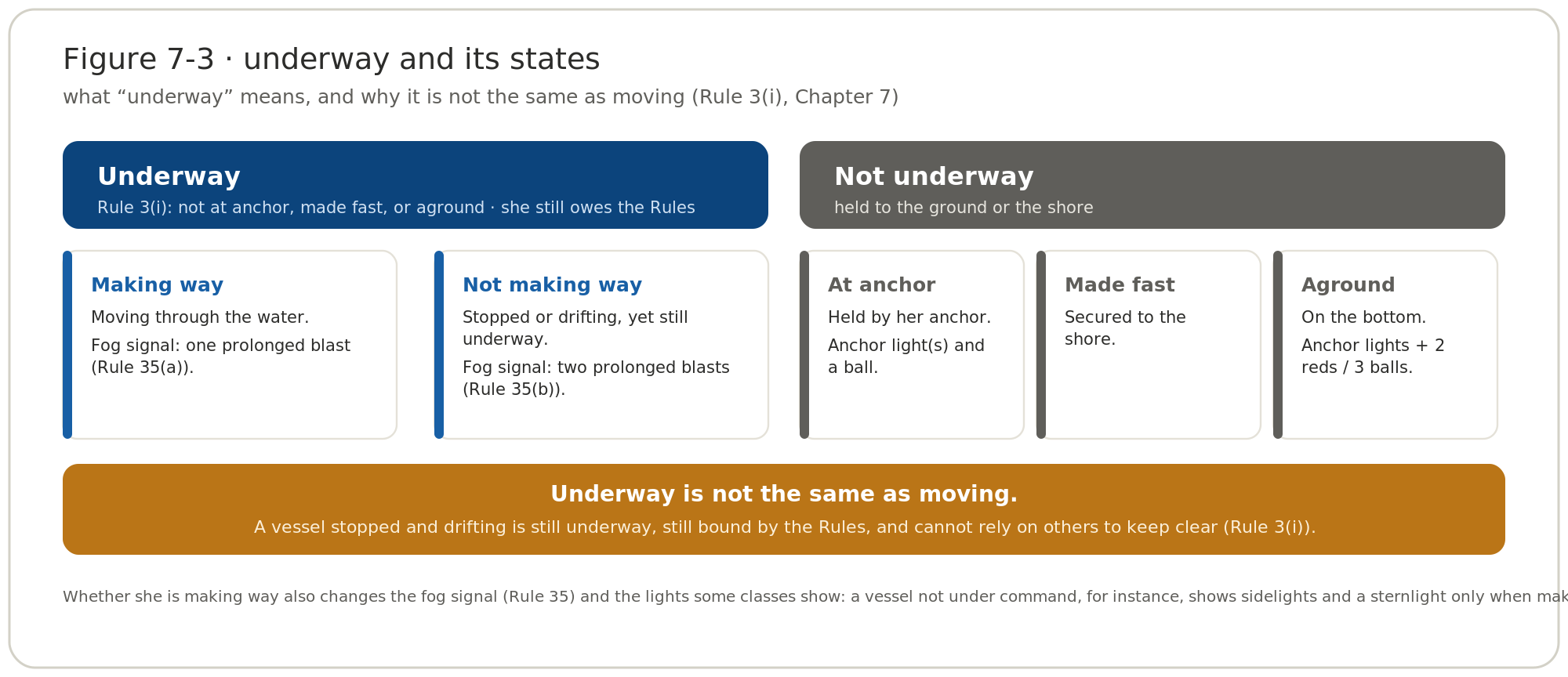
Figure 7-3. Underway and its states. What “underway” means under Rule 3(i) and why it is not the same as moving: a vessel underway is either making way or stopped and making no way, and the fog signals of Rule 35 treat the two as different states.
In sight means seen, by eye
The second defined term is the one the whole instrument turns on, and Chapter 5 has already leaned on it: in sight. Rule 3(k) provides that vessels “shall be deemed to be in sight of one another only when one can be observed visually from the other” (MISCPUB 0127, Rule 3(k)). Everything turns on the word “visually.” A contact held on radar, however sharp and certain, is not in sight, and the consequence is the one the architecture turns on. The give-way and stand-on rules of Section II apply only to vessels in sight, so a radar contact in restricted visibility is governed by Rule 19 and not by the crossing or head-on rules at all. The single most expensive vocabulary error an officer can make is to treat a vessel he holds only on radar as though he could see her, and start applying the in-sight rules to her. The definition exists to forbid exactly that.
The vessel classes say more than they seem to
The classes of vessel in Rule 3 each carry an implication that the bare label hides. A power-driven vessel is simply one “propelled by machinery” (Rule 3(b)), and she is the default that most encounters assume. A sailing vessel is one under sail “provided that propelling machinery, if fitted, is not being used” (Rule 3(c)), and the proviso is the trap: a yacht motor-sailing with her engine engaged is a power-driven vessel, loses any priority a sailing vessel would have had, and must show power-driven lights. A vessel engaged in fishing is one using gear “which restrict[s] manoeuvrability” (Rule 3(d)), so the act of fishing is not enough on its own. A vessel trolling, or one merely carrying nets she has not deployed, is not a fishing vessel in the eyes of the Rules.
The two restricted classes turn on a distinction worth holding. A vessel not under command is one which “through some exceptional circumstance” cannot manoeuvre as the Rules require (Rule 3(f)), while a vessel restricted in her ability to manoeuvre is one which “from the nature of her work” cannot (Rule 3(g)). The key word in the second is “work.” RAM status comes from what a vessel is doing, not from what she is. A tug is restricted while a tow severely constrains her, and an ordinary power-driven vessel an hour later in transit. And the six activities the rule lists, from dredging to replenishment to mineclearance, are expressly not the whole list (BR45 Vol 4, para 1014c).
The class that most rewards a close reading, and the one worth ending on, is the vessel constrained by her draught. Rule 3(h) defines her as “a power-driven vessel which, because of her draught in relation to the available depth and width of navigable water, is severely restricted in her ability to deviate from the course she is following” (MISCPUB 0127, Rule 3(h)). The first three words are the point. A CBD vessel is, by definition, a power-driven vessel, and that has a consequence officers miss: she is not a privileged class in the way a NUC or RAM vessel is. The Rules do not place her in the keep-out-of-the-way order of Rule 18(a). Instead, other vessels are told only to “avoid impeding the safe passage” of a vessel constrained by her draught (MISCPUB 0127, Rule 18(d)), a not-impede duty rather than a give-way one, while she for her part must “navigate with particular caution” (Rule 18(d)(ii)) and may show the lights of Rule 28. So an ordinary crossing or head-on situation can and does develop with a CBD vessel, governed by the normal steering and sailing rules, because she is a power-driven vessel like the one meeting her. The worked case at the end of the chapter turns on exactly this.
The undefined terms, and why they stay open
The second kind of word is the kind the Rules will not pin down, and Chapter 9 has already argued why. A fixed number that is safe for one ship is lethal for another, so the drafters left these terms to judgement on purpose. Read them not for a definition but for the question they hand you.
Safe speed, in Rule 6, is the model. The rule never names a speed. It lists the things a safe speed must take into account: the state of visibility, the traffic density, the vessel’s own manoeuvrability and stopping distance, background light at night, the wind, sea and current, the draught against the depth, and for radar-fitted vessels a further set of considerations (MISCPUB 0127, Rule 6). Safe speed is whatever speed lets a vessel stop or manoeuvre in time given all of those, and it is therefore different for every vessel in every condition. The factor list deserves to be carried in the head.
A close-quarters situation, used in Rules 8 and 19 but nowhere defined, is the stage at which a collision becomes a real and pressing possibility if nothing is done, sitting between the existence of risk of collision and the collision itself. It carries no fixed distance, but the guidance reflects vessel size and conditions. In the open sea, distances of the order of two to three miles are commonly treated as the outer limit, smaller for some vessels, with at least two miles a usual figure in restricted visibility (Cockcroft & Lameijer, 7th ed, comments on Rules 7 and 19). Ample time, in Rules 8 and 19, means early enough that the action is effective and does not itself create an emergency, which again depends on the closing speed and the room available. Safe distance, in Rule 8(d), is the passing distance that action must achieve, varying with size, speed and the interaction between vessels passing close aboard. And a narrow channel or fairway, in Rule 9, is left to the waters themselves. What is narrow for a large ship is open for a small one.
Two of the undefined terms belong mainly to other chapters, and are noted here only so the reader knows where they live. Finally past and clear, which ends an encounter in Rules 8(d) and 13(d), means the encounter is genuinely over, with the other vessel well abaft and enough separation that no collision-avoidance relationship sensibly persists. Its three undefined parts, and the trap of judging it too early, are Chapter 9’s. And good seamanship, or the ordinary practice of seamen, in Rules 2 and 8, is the whole subject of Chapter 10, the assumed body of professional practice the Rules build on. Here it is enough to mark it as the standard against which every undefined term is ultimately judged.
The pattern across all of them is one idea. Each is undefined because the correct value genuinely depends on the vessels and the circumstances, so the rule states the consideration and hands the measurement to the mariner, to be made to the standard of good seamanship. The defined terms tell you which rule applies. The undefined terms tell you how much, and leave the how-much to you.
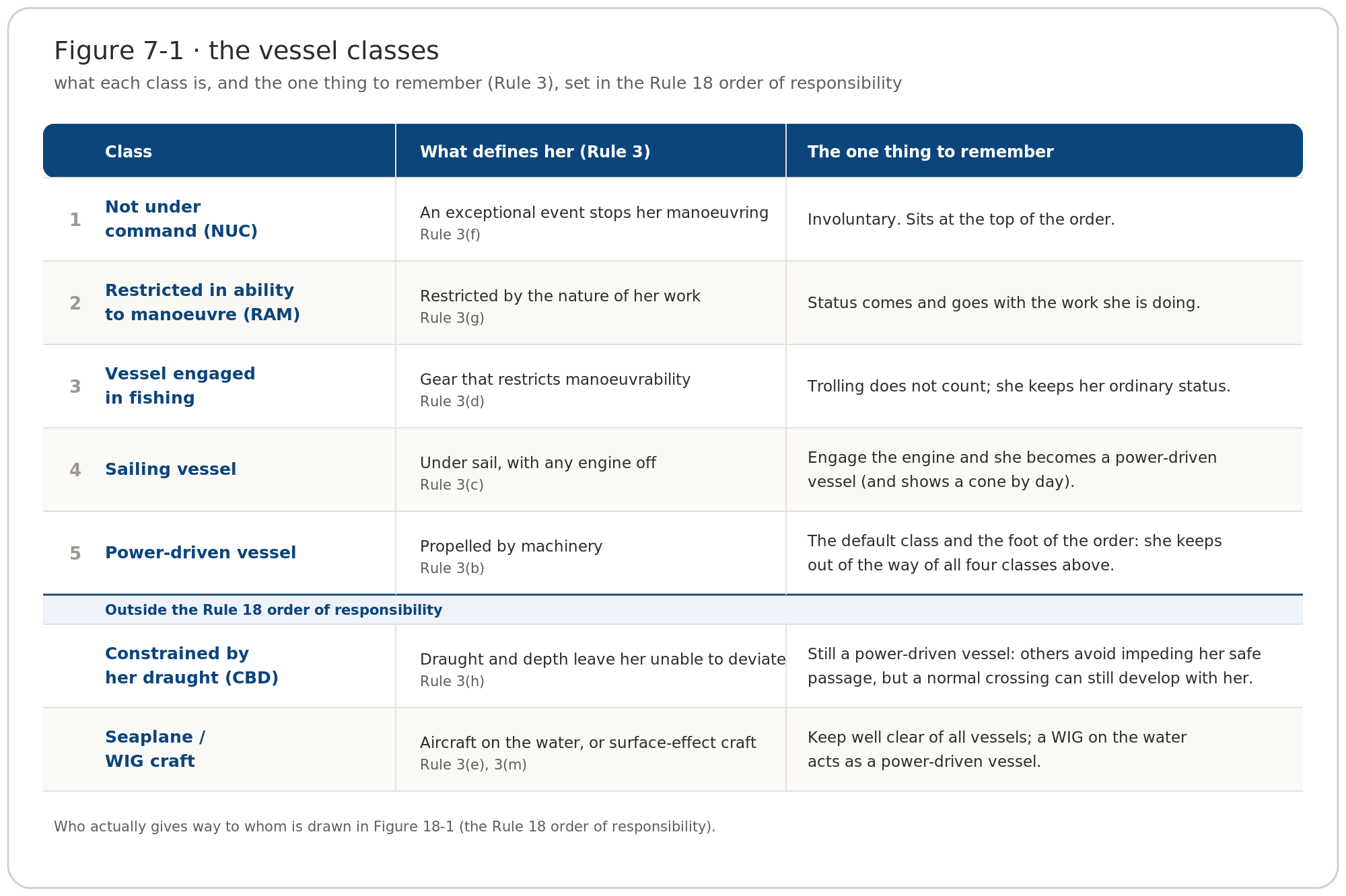
Figure 7-1. The vessel classes. Each class with its defining test under Rule 3 and the one thing to remember, set in the Rule 18 order of responsibility. Reference, not teaching; it pairs with the Rule 18 ladder drawn in Part II (Figure 18-1).
A short worked case: a crossing with a constrained vessel
You are conning a power-driven vessel in the approaches to a major port. Another power-driven vessel is crossing from your port side, showing, by day, the three vertical balls of a vessel constrained by her draught, and the range is closing on a steady bearing. The instinct, and it is a common and dangerous one, is to read “constrained” as “privileged” and to assume she has the right of way, so you hold on and wait for nothing in particular. That is the vocabulary error this chapter exists to prevent. A vessel constrained by her draught is, by Rule 3(h), a power-driven vessel, and the encounter between you is therefore an ordinary crossing situation under Rule 15. She has you on her own port side, which makes her the stand-on vessel and you the give-way vessel, not because of her draught but because of the geometry, and your duty is to keep out of her way with early and substantial action. Her constrained status does not reverse that. It adds to it, because Rule 18(d) tells you additionally to avoid impeding her safe passage, which only reinforces that the action is yours to take. There is no right of way to invoke and no privilege to wait on. The two defined words, “power-driven vessel” buried inside the definition of “constrained by her draught,” decided the whole encounter, and reading them correctly is the difference between giving way in good time and standing into danger on a misunderstanding.
See also: Ch 5 (Rule 3 as the first check, and the in-sight test), Ch 6 (“deemed” and the legal force of the defining words), Ch 9 (why the undefined terms are left open, and the “finally past and clear” tension), Ch 10 (good seamanship, the standard the undefined terms are judged against), the back matter (the full A–Z glossary and the annotated rules), and Part II, where each defined class is taken up with its lights and its place in the Rule 18 order.