Chapter 8: How Situations Develop
IN BRIEF · An encounter is a process. Nothing happens until risk of collision exists, except overtaking, which engages on geometry alone and locks until finally past and clear; then an in-sight encounter runs through four stages that change what each vessel must do. Not-impede duties operate upstream and never convert into a right of way, and you cannot manufacture a privileged position by your own manoeuvre.
A rule is not something you apply once and have done with. An encounter is a process. It moves through phases, and different rules govern different phases, so the rule that is right at one moment is wrong a few minutes later. The give-way and stand-on roles do not exist at long range. They switch on at a definite point, change what each vessel must do as the range closes, and finally switch off again. An officer who has learned the Rules as a flat list of obligations, without the sense of timing that tells him where in the process he is, will reach for the right rule at the wrong moment. This chapter is about the life of an encounter, from the first contact on the radar to finally past and clear, and the Rules that govern each stage of it.
Nothing happens until there is risk of collision
The first thing to understand about how a situation develops is that, for most of the Rules, it has not developed at all until risk of collision exists. The encounter rules are written with that trigger built in. Rule 14 applies to vessels meeting “so as to involve risk of collision,” Rule 15 to vessels crossing “so as to involve risk of collision,” and the same phrase or its equivalent gates the others. Until risk of collision exists, two vessels may be in plain sight of each other, even closing, with neither under any obligation to give way or to stand on. BR45 puts the concept at the centre of the whole instrument: risk of collision lies at the heart of the Rules, and Rules 12, 14, 15 and 19(d) and (e) come into effect only when it exists, with Rules 16, 17, 18 and 34 following by implication (BR45 Vol 4, para 1018). So the question that starts every encounter is not “who gives way” but “does risk of collision exist yet,” because the answer is what switches the rest on.
Rule 7 is the rule that answers it, and it is worth knowing exactly what it requires. A vessel shall use all available means appropriate to the circumstances to determine whether risk of collision exists, and if there is any doubt, the risk shall be deemed to exist (MISCPUB 0127, Rule 7(a)). The rule then gives the classic test, and a warning against trusting it too far: risk shall be deemed to exist if the compass bearing of an approaching vessel does not appreciably change, but such risk may sometimes exist even when the bearing is changing, particularly with a very large vessel, a tow, or at close range (MISCPUB 0127, Rule 7(d)). The steady compass bearing is the heart of it, but the rule deliberately refuses to let you treat a changing bearing as proof of safety. Determining risk of collision is therefore the first act of seamanship in any encounter, and Rule 5’s look-out and Rule 7’s assessment are what feed it.
PRACTICAL NOTE: a steady bearing is the trigger, not a tight bearing
The error to guard against is waiting for the other vessel to look close before treating the situation as real. A contact that holds a steady compass bearing while the range falls is, by Rule 7(d), already a risk of collision, however far off it still is. The encounter has begun, and your obligations with it. The whole point of long-range scanning and early plotting under Rule 7(b) is to catch that steady bearing while there is still room and time to act on it cheaply.
The asymmetry of overtaking
There is one major exception to the rule that nothing happens until risk of collision exists, and it shapes how overtaking situations develop quite differently from any other. Rule 13 contains no risk-of-collision trigger. A vessel is overtaking once she is coming up with another from more than 22.5 degrees abaft the beam (MISCPUB 0127, Rule 13(b)), and the courts have held that the overtaking rule begins to operate before there is risk of collision, as soon as it can properly be said that one vessel is coming up with the other (Olympian–Nowy Sacz, Court of Appeal, 1977, cited in Cockcroft & Lameijer, 7th ed, comment on Rule 13). Overtaking therefore engages earlier than crossing or head-on. It also overrides them, applying notwithstanding anything in Sections I and II (MISCPUB 0127, Rule 13(a)), and it lasts longer, because once the overtaking relationship attaches it is locked until the vessels are finally past and clear, and no later change of bearing converts the overtaking vessel into a crossing vessel (MISCPUB 0127, Rule 13(d)). So an overtaking situation begins sooner, cannot be escaped by manoeuvring, and ends only when the geometry has fully resolved. That asymmetry, treated as a drafting tension in Chapter 9, is best understood here as a fact about timing: the overtaking duty starts early and ends late.
The four stages of an encounter
Once risk of collision exists between two vessels in sight, the encounter moves through four stages, and the Rules assign different obligations to each. Knowing which stage you are in is the practical core of this chapter.
In the first stage, at long range before risk of collision exists, both vessels are free. Neither is give-way, neither is stand-on, and either may manoeuvre as she pleases. This is the cheapest place to resolve an encounter, and good seamanship often does its best work here, with a small early alteration that removes the risk before the Rules ever engage.
In the second stage, risk of collision first applies, and the roles are set. The give-way vessel is now obliged to act, taking early and substantial action to keep well clear under Rules 16 and 8, and the stand-on vessel shall keep her course and speed under Rule 17(a)(i) (MISCPUB 0127, Rules 16 and 17). This is the stable, designed configuration of an encounter: one vessel manoeuvres, the other holds, and each can predict the other precisely because the Rules have told them their parts.
In the third stage, it becomes apparent that the give-way vessel is not taking appropriate action. The stand-on vessel is now permitted to act on her own manoeuvre under Rule 17(a)(ii), and either vessel in doubt about the other’s intentions should give at least five short and rapid blasts, the doubt signal of Rule 34(d) (MISCPUB 0127, Rules 17 and 34(d)). The stable configuration is breaking down, and the Rules begin to hand initiative back to the stand-on vessel.
In the fourth stage, collision can no longer be avoided by the give-way vessel’s action alone. The stand-on vessel is now required to take such action as will best aid to avoid collision under Rule 17(b), and the restrictions on her have lifted (MISCPUB 0127, Rule 17(b)). This is the last stage before contact, and both vessels are now doing whatever will avoid the collision.
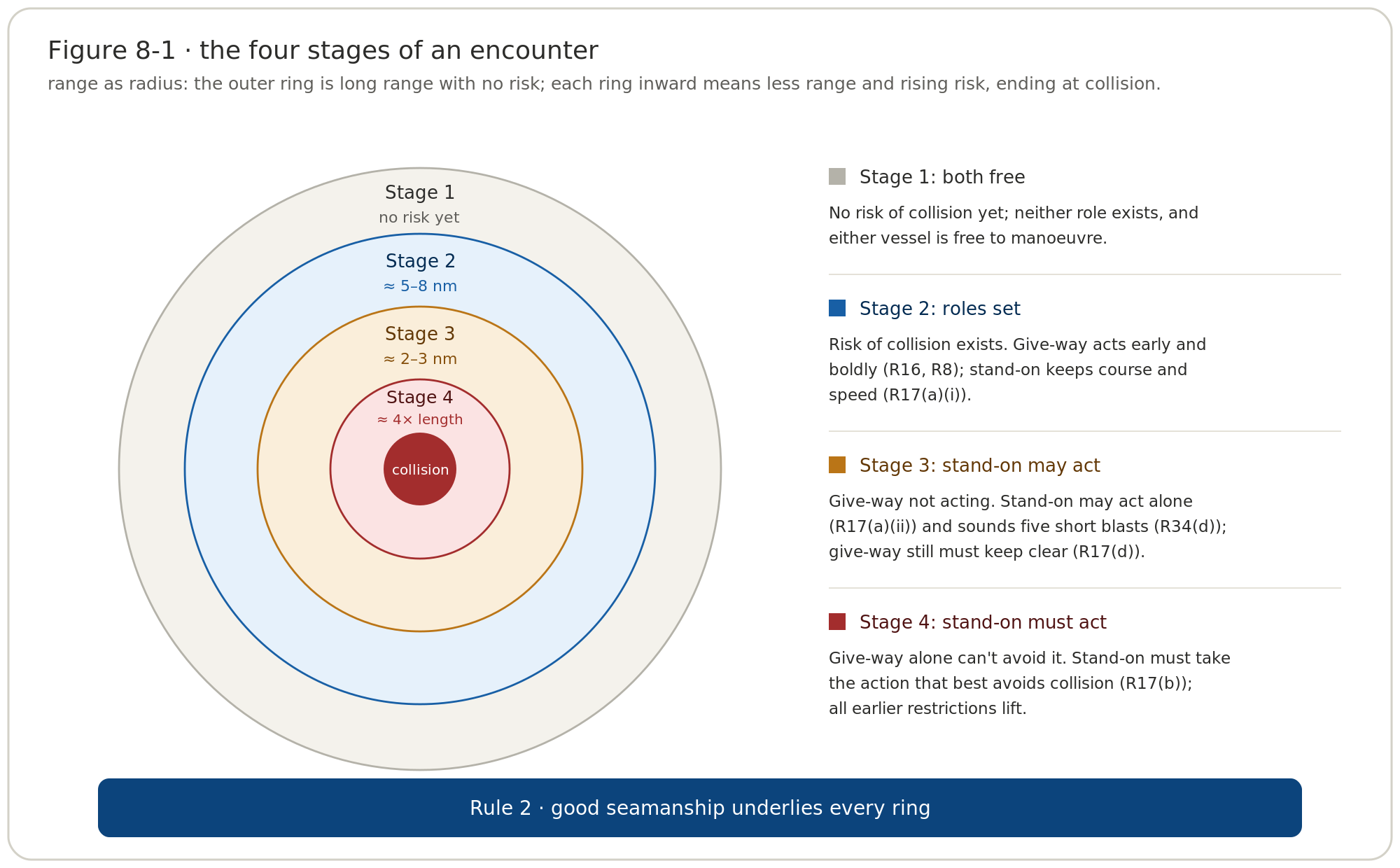
Figure 8-1. Timeline of the four stages of an encounter. From long range with both vessels free to the point where the stand-on vessel must act, each stage labelled with its governing rule. The boundaries are drawn soft because the transitions are judgement calls, not fixed ranges.
Cockcroft does attach distances to these stages, and they are worth knowing, provided they are held as guidance reflecting court practice rather than rules of law. For a crossing between two power-driven vessels in the open sea he suggests the outer limit of the second stage is of the order of 5 to 8 miles and the outer limit of the third stage about 2 to 3 miles, while stressing that these will be much greater for high-speed vessels in a fine crossing (Cockcroft & Lameijer, 7th ed, comment on Rule 17, “The four stages in a collision situation”). The most telling part is how he fixes the fourth stage, where the stand-on vessel’s action becomes compulsory: not by a set range but by the size of the ship. The distance at which the give-way vessel’s action alone can no longer avoid collision is usually about four times the give-way vessel’s length, and in the open sea a stand-on vessel should not let a give-way vessel approach to less than about twelve times a ship’s length in a crossing without taking avoiding action (Cockcroft & Lameijer, 7th ed, comment on Rule 17). Those length-based figures are the clearest the guidance gets, and they make the dependence explicit: the right distance scales with the vessel, which is precisely why the Rules themselves name no number, as Chapter 9 sets out. The open-sea mileages are a useful scale to carry in the head, but they are the two-merchant-ship case, not a threshold to apply to a fast warship or a very large ship without adjustment.
When one situation ends and another begins
A situation ends when the vessels are finally past and clear, the phrase that closes both Rule 8(d) and Rule 13(d), and which Chapter 9 examines for its deliberate vagueness. The harder question is when a new situation can begin out of the tail of an old one. For overtaking, the answer turns entirely on whether risk of collision existed during the overtaking geometry. If it did, Rule 13(d) holds the vessels in the overtaking relationship until they are finally past and clear, and no new crossing can develop in between. If it never did, because the vessels were always going to pass well clear, then the encounter rules never engaged at all, and a genuine crossing can develop fresh once the geometry shifts and risk of collision arises. This is what the court held in Auriga–Manuel Campos, 1977, where vessels in an overtaking aspect but shaping to pass about three miles off were governed by the crossing rule for the later close-quarters situation (cited in Cockcroft & Lameijer, 7th ed, comment on Rule 13). The practical point for situation awareness is that you must know not only what the geometry is now but what it was, because the history of an encounter can still be governing the present.
Two kinds of obligation: keep out of the way, and not impede
There is a second structure layered over the stages, and confusing its two halves is a common source of error. The Rules contain two distinct kinds of obligation that operate at different points in the life of a situation.
The first is the reactive one, keep out of the way, which lives in the encounter rules: Rules 13, 14, 15 and 18. It allocates responsibility between two specific vessels once risk of collision exists, designating one give-way and the other stand-on, with complementary duties that end when the vessels are finally past and clear. This is the framework the four stages describe.
The second is the preventative one, not to impede, found in rules such as 9(b), 9(c) and 9(d) for narrow channels, in Rule 10 for traffic separation schemes, and in Rule 18(d). It operates upstream of risk of collision. It requires certain vessels, a small vessel in a narrow channel, or a vessel crossing a traffic lane, to navigate so as not to get in the way of another in the first place, by taking early action to leave sufficient sea room. It creates no stand-on or give-way relationship. It is an obligation to avoid creating a situation at all.
The two are bridged by Rule 8(f), which is one of the most important and least understood provisions in the instrument, and it must be read in its three parts. A vessel required not to impede shall, when the circumstances require, take early action to allow sufficient sea room for the safe passage of the other (MISCPUB 0127, Rule 8(f)(i)). She is not relieved of that obligation if she nonetheless ends up approaching the other so as to involve risk of collision, and when she acts she must have full regard to what the steering and sailing rules require (MISCPUB 0127, Rule 8(f)(ii)). And critically, the vessel whose passage is not to be impeded remains fully obliged to comply with the steering and sailing rules when the two are approaching so as to involve risk of collision (MISCPUB 0127, Rule 8(f)(iii)).
The consequence is the one officers most often get wrong. When a not-impede situation deteriorates into a risk-of-collision situation, the not-impede obligation does not disappear. The encounter rules simply layer on top, so that both vessels are now burdened. The vessel whose passage was not to be impeded cannot sit on her privileged status and trust the other to clear. Once risk of collision exists, she must comply with the steering and sailing rules like anyone else.
PRACTICAL NOTE: the small vessel that failed to keep clear
A vessel under twenty metres in a narrow channel must not impede a vessel that can navigate only within it (Rule 9(b)), and she should take early action to stay out of the fairway. Suppose she fails, and risk of collision now exists. The large vessel does not get to hold her course and speed trusting the small vessel to get out of the way. Under Rule 8(f)(iii) she too must now comply with the encounter rules. Both vessels are burdened, the small one for failing to keep clear and the large one for failing to act once risk of collision arose. “Not to be impeded” was never the same thing as “right of way.”
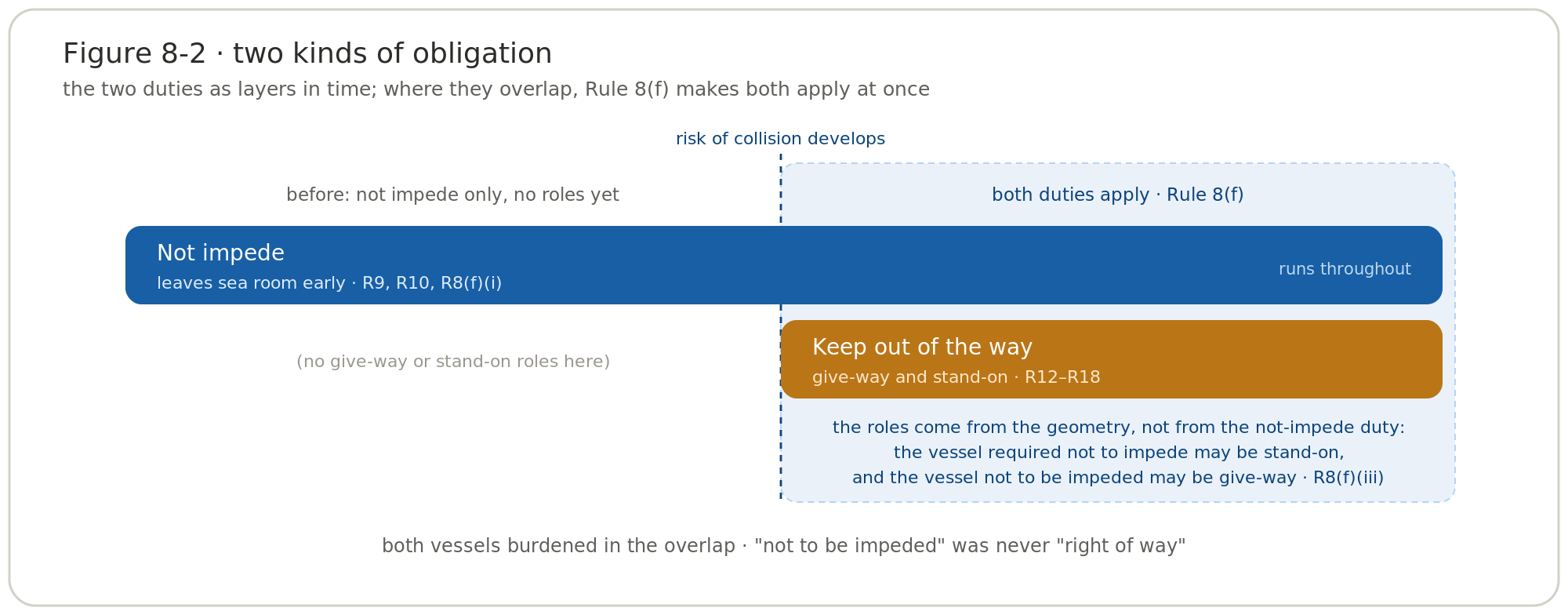
Figure 8-2. Not-impede versus keep-out-of-the-way. The preventative duty operates upstream, before risk of collision and with no give-way or stand-on roles; the reactive duty is the bilateral relationship once risk exists. Rule 8(f) bridges them: when a not-impede situation becomes a risk-of-collision situation, both obligations apply and both vessels are burdened. The roles in the overlap come from the encounter geometry alone, so the vessel required not to impede may find herself the stand-on vessel, and the vessel not to be impeded the give-way vessel (Rule 8(f)(iii)).
You cannot manufacture a privileged position
One principle deserves to be drawn out on its own, because it follows from everything above and it traps officers who think of the Rules as conferring rights. You cannot create a situation by your own manoeuvre and then claim the privileged role the resulting geometry would hand you. The Rules allocate roles by the situation as it honestly arises, not by the situation you engineer.
It is codified for overtaking. An overtaking vessel cannot sheer off to one side, manufacture a crossing geometry, and announce that she is now the stand-on vessel, because Rule 13(d) provides that a subsequent alteration of bearing makes her neither a crossing vessel nor free of her duty to keep clear until finally past and clear (MISCPUB 0127, Rule 13(d)). The text rules it out. Outside overtaking the same principle holds through Rule 2. A vessel that brings about a close-quarters situation by her own action cannot then claim the protected role the geometry would give her, because the ordinary practice of seamen does not include profiting from your own default, and the special-circumstances limb of Rule 2 can require her to act regardless of the nominal allocation (and see Chapter 10). The deepest version of the point is the one Chapter 1 made: the Rules confer no right of way at all. There is no privilege to be won, only duties placed on both vessels, so the very instinct to manoeuvre yourself into an advantaged role misreads what the Rules are. A warship working in formation, constantly changing the geometry around her, is unusually exposed to this error, which is why Chapter 4 flagged it and why it belongs here in full.
A short worked case: a stand-on vessel through all four stages
You are the stand-on vessel in a crossing at night, another power-driven vessel on a steady bearing fine on your port bow, the range falling. Walk it through. In the first stage, while she was still far off and her bearing was drawing, there was no risk of collision and neither of you was bound. You simply watched her. Then her bearing steadied while the range kept falling, and by Rule 7(d) risk of collision came into existence, putting you into the second stage. She is the give-way vessel, and you are now obliged to keep your course and speed under Rule 17(a)(i), precisely so that she can predict you while she acts. You hold your course and speed. The range continues to fall and she has not altered. As it becomes apparent that she is not taking appropriate action you pass into the third stage. You sound at least five short and rapid blasts to signal your doubt under Rule 34(d), and you are now permitted to act on your own manoeuvre under Rule 17(a)(ii), though if you do you must not, in a crossing, turn to port for a vessel on your own port side (Rule 17(c)). She still does not alter. Finally the range closes to the point where her action alone could no longer prevent contact, and you are in the fourth stage. Rule 17(b) now requires you to take whatever action will best avoid collision, and every earlier restriction has lifted. One encounter, four stages, four different sets of obligations on you, selected by nothing but how the situation developed. Reading that development correctly, and knowing at every moment which stage you are in, is the skill this chapter exists to build.
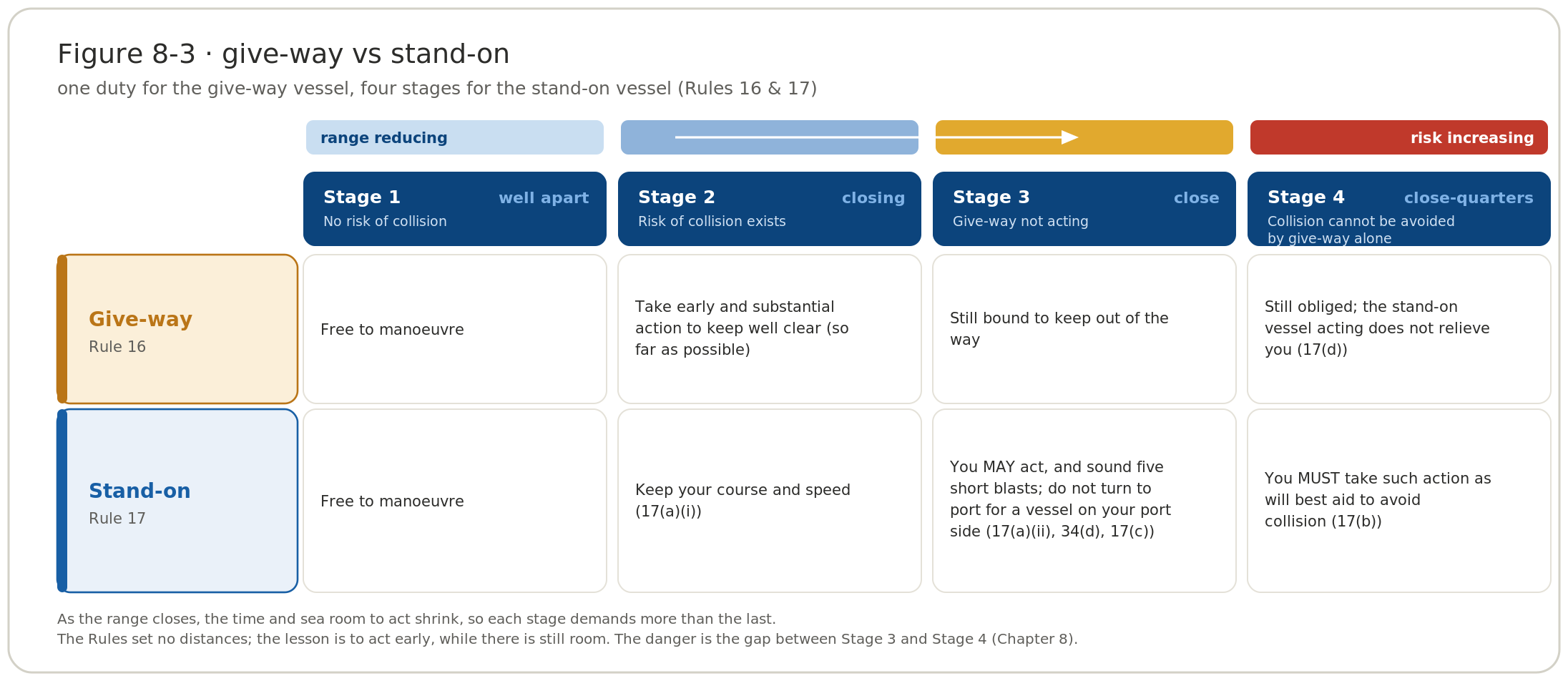
Figure 8-3. Give-way versus stand-on. One duty for the give-way vessel, four stages for the stand-on vessel (Rules 16 and 17): the give-way vessel’s obligation never changes, while what the stand-on vessel must, may and finally shall do is selected by the stage the encounter has reached.
See also: Ch 1 (predictability, and why there is no right of way to win), Ch 5 (the visibility-state structure that decides whether these in-sight stages apply at all), Ch 9 (the tensions in Rules 7, 13 and 17 that this lifecycle runs through), Ch 10 (Rule 2 and the standard behind the manufactured-stand-on principle), and Part II, where Rules 7, 8, 13, 16 and 17 are each taken up in turn.