Chapter 13: Parts C and D, Lights, Shapes, Sound and Light Signals (Rules 20 to 37)
Parts C and D are the input side of the conduct Rules (Chapter 5): the lights and shapes tell you what a vessel is and which way she is heading, and the sound signals tell you what she is doing, so that the Section II and III Rules can act on the answer. The treatment here is concise prose, with the light-arc, signature, shape and signal figures placed at the rules they serve.
Part C: Lights and Shapes
Rule 20: Application · CONCISE
Lights are shown from sunset to sunrise, and in restricted visibility, and may be shown at any other time when needed; during the dark hours no other lights may be shown that could be mistaken for prescribed lights or impair their visibility. Shapes are shown by day. The Rule also makes the Annex I technical specifications binding. See: Ch 5 (Parts C/D feed the conduct Rules).
The rule’s text, word for word and annotated: Rule 20 in Appendix B.
Rule 21: Definitions (Lights) · CONCISE
The arcs are the thing to learn, because the conduct Rules are built on them. The masthead light covers 225 degrees (an unbroken arc from right ahead to 22.5 degrees abaft each beam); each sidelight covers 112.5 degrees on its side; the sternlight covers the remaining 135 degrees. Masthead plus sternlight, and the two sidelights plus sternlight, each total 360. The 22.5-degrees-abaft-the-beam line where the sidelight gives way to the sternlight is the exact boundary Rule 13(b) uses to define overtaking, which is why a vessel who can see only your sternlight is overtaking you.
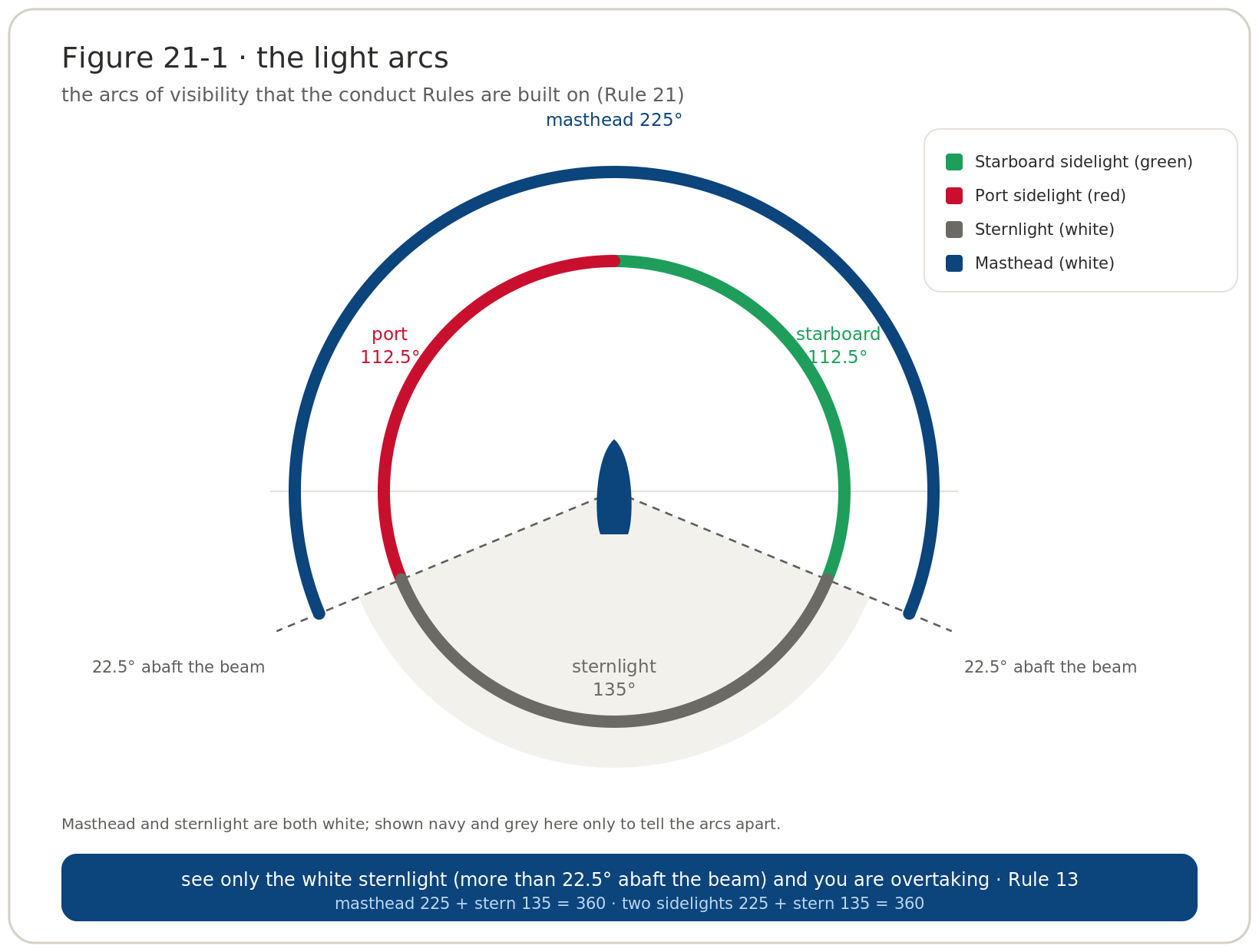
Figure 21-1. The light arcs. Plan view of a power-driven vessel with the 225° masthead, 112.5° sidelight and 135° sternlight arcs drawn to scale, the 22.5°-abaft-the-beam lines marked. The sternlight arc is exactly the Rule 13 overtaking sector, which is why a vessel who can see only your sternlight is overtaking you. Referenced from Rules 13, 23 and 26.
See: Ch 7 (“abaft the beam”), Rule 13 (the overtaking sector).
The rule’s text, word for word and annotated: Rule 21 in Appendix B.
Rule 22: Visibility of Lights · CONCISE
The Rule sets minimum ranges at which lights must be visible in clear air, scaled by vessel length, which fix the distance at which a vessel should be picked up at night. Reference detail; an OOW needs the principle, not the table by heart. See: Rule 6 (these ranges bear on safe speed at night).
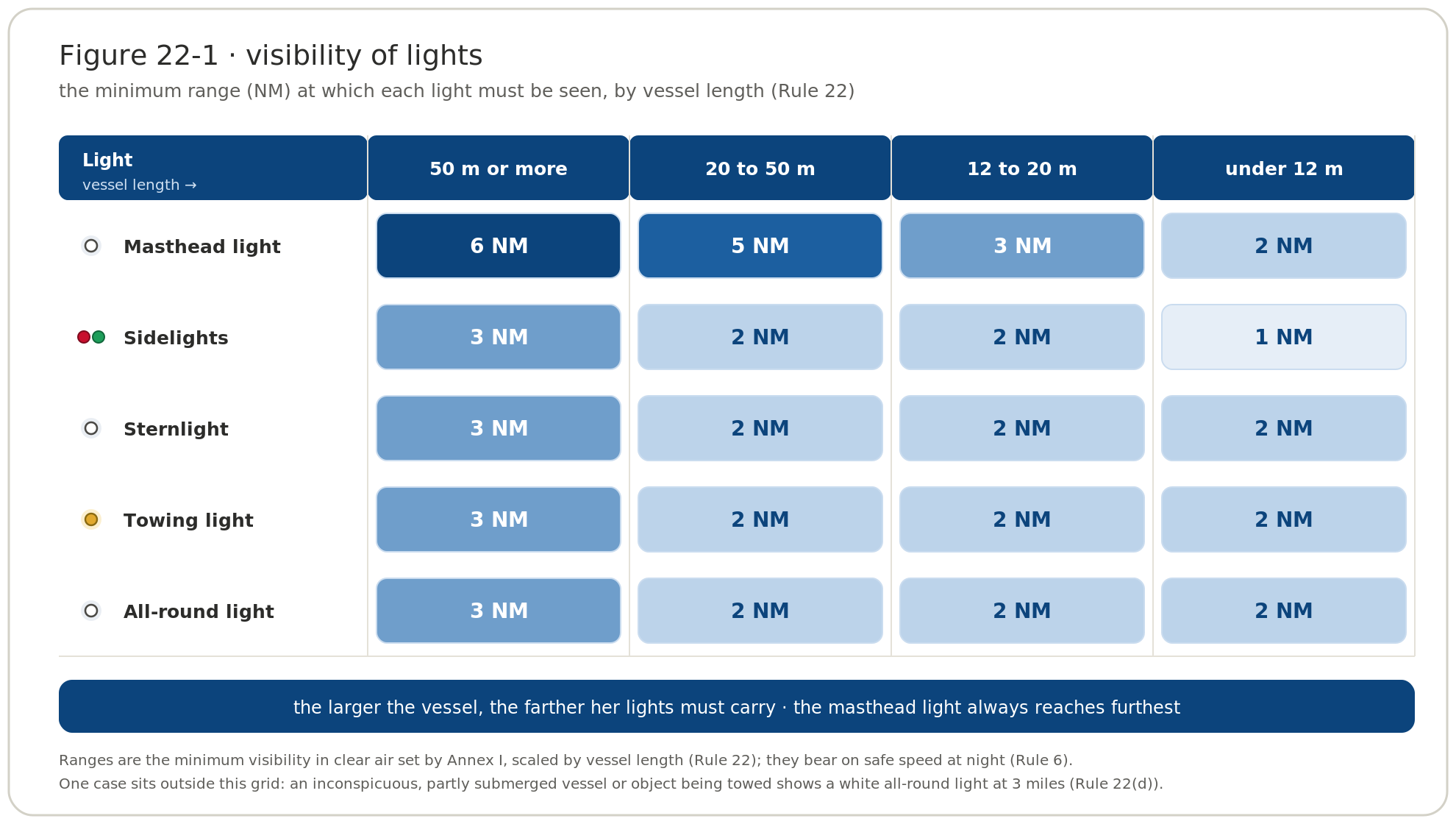
Figure 22-1. Visibility of lights. The minimum range in nautical miles at which each light must be seen, by vessel length (Rule 22). Reference, not memorisation.
The rule’s text, word for word and annotated: Rule 22 in Appendix B.
Rule 23: Power-driven Vessels Underway · CONCISE
A power-driven vessel underway shows a masthead light, sidelights and a sternlight, with a second (after) masthead light on vessels of 50 metres or more. The two masthead lights are a heading indicator: their vertical alignment and horizontal separation let an observer read which way she is pointing, and when they come into a line she is heading straight towards or away. See: Rule 21 (arcs), Ch 7 (power-driven as the default class).
.png)
Figure 23-1a. Light and shape signatures: the working states (Rules 23 to 27). The master recognition table, first half: power-driven, towing, sailing, trawling, fishing, not under command, and restricted in ability to manoeuvre. The single most-used reference in the guide; Figures 23-2 and 23-3 below are its quick-read companions.
.png)
Figure 23-1b. Light and shape signatures: constrained, stationary and special states (Rules 28 to 30; 23(b), (c), 27(e), (f)). The master recognition table, second half: constrained by her draught, pilot on duty, at anchor, aground, and the special and esoteric lights.
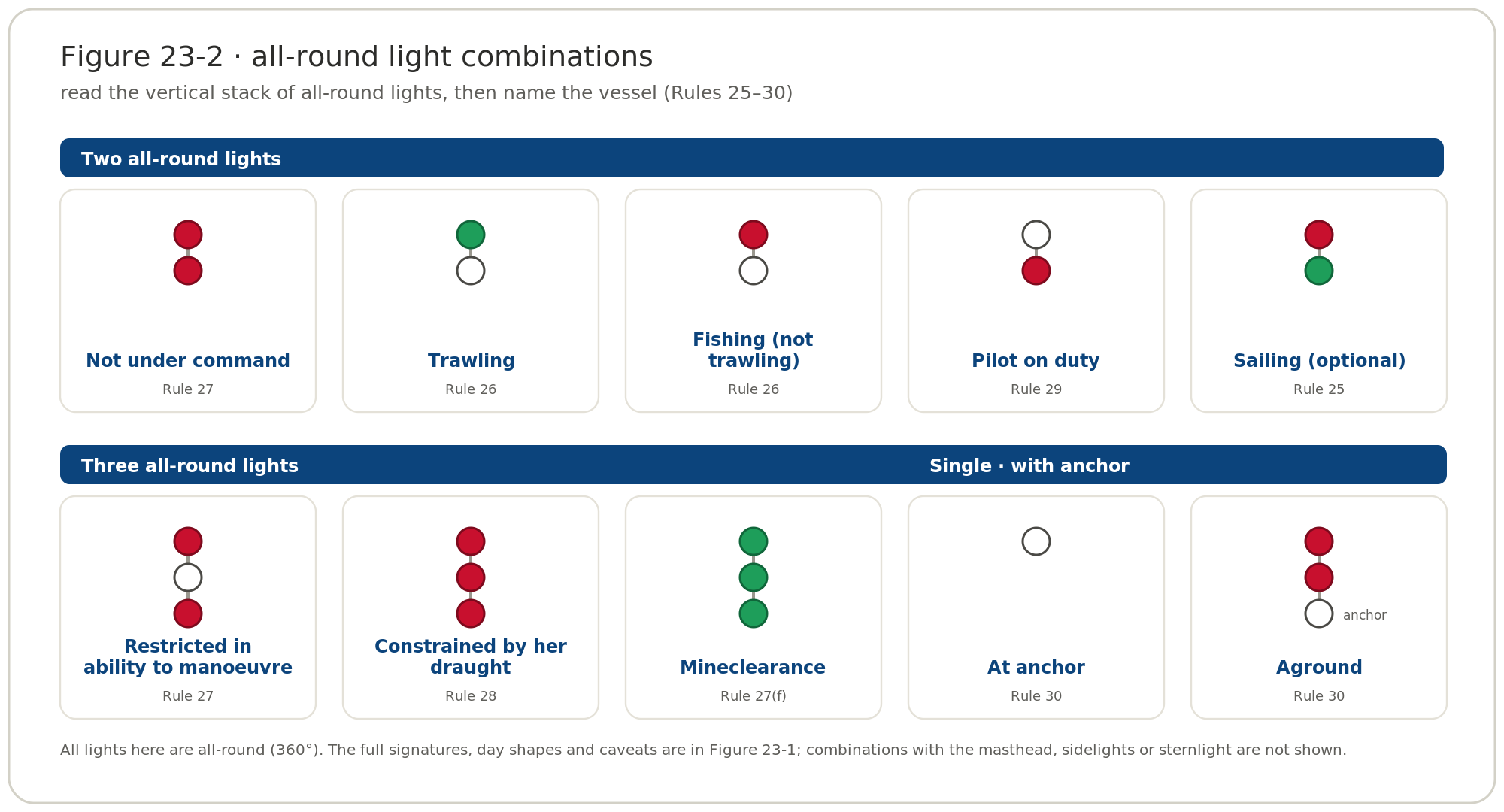
Figure 23-2. All-round light combinations. Read the vertical stack of all-round lights, then name the vessel (Rules 25–30).
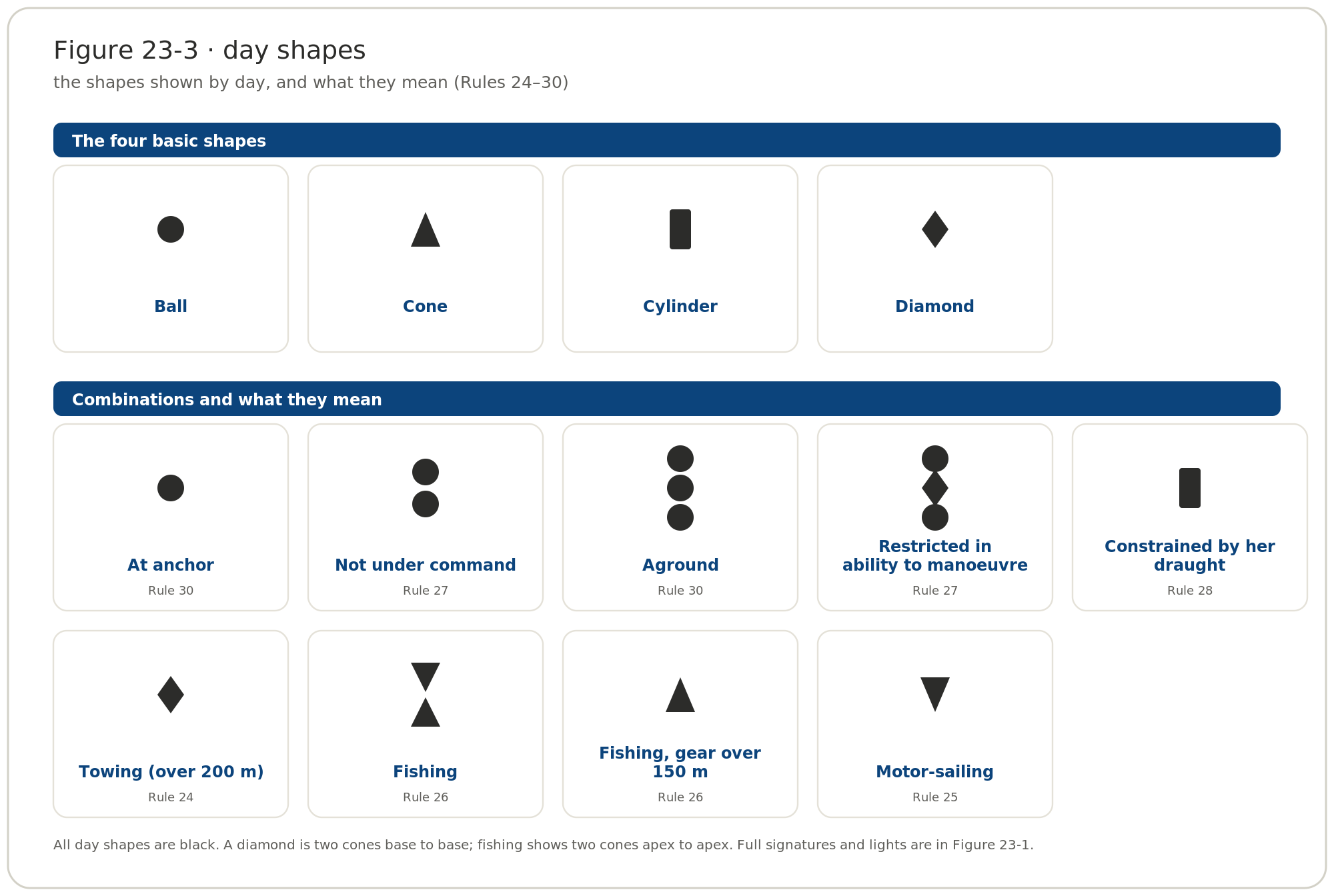
Figure 23-3. Day shapes. The shapes shown by day and what they mean (Rules 24–30), built from the four basic shapes.
The rule’s text, word for word and annotated: Rule 23 in Appendix B.
Rule 24: Towing and Pushing · CONCISE
A towing vessel shows an extra masthead light in a vertical line (two, or three when the tow exceeds 200 metres), sidelights, a sternlight and a towing light above the sternlight, with a diamond shape by day when the tow is long. The point of the signal is to warn of a large, poorly-lit obstruction strung out behind the towing vessel; the 200-metre threshold marks when that hazard is treated as serious. See: Rule 35 (the towing sound signal), Ch 7 (RAM where a tow severely restricts the tug).
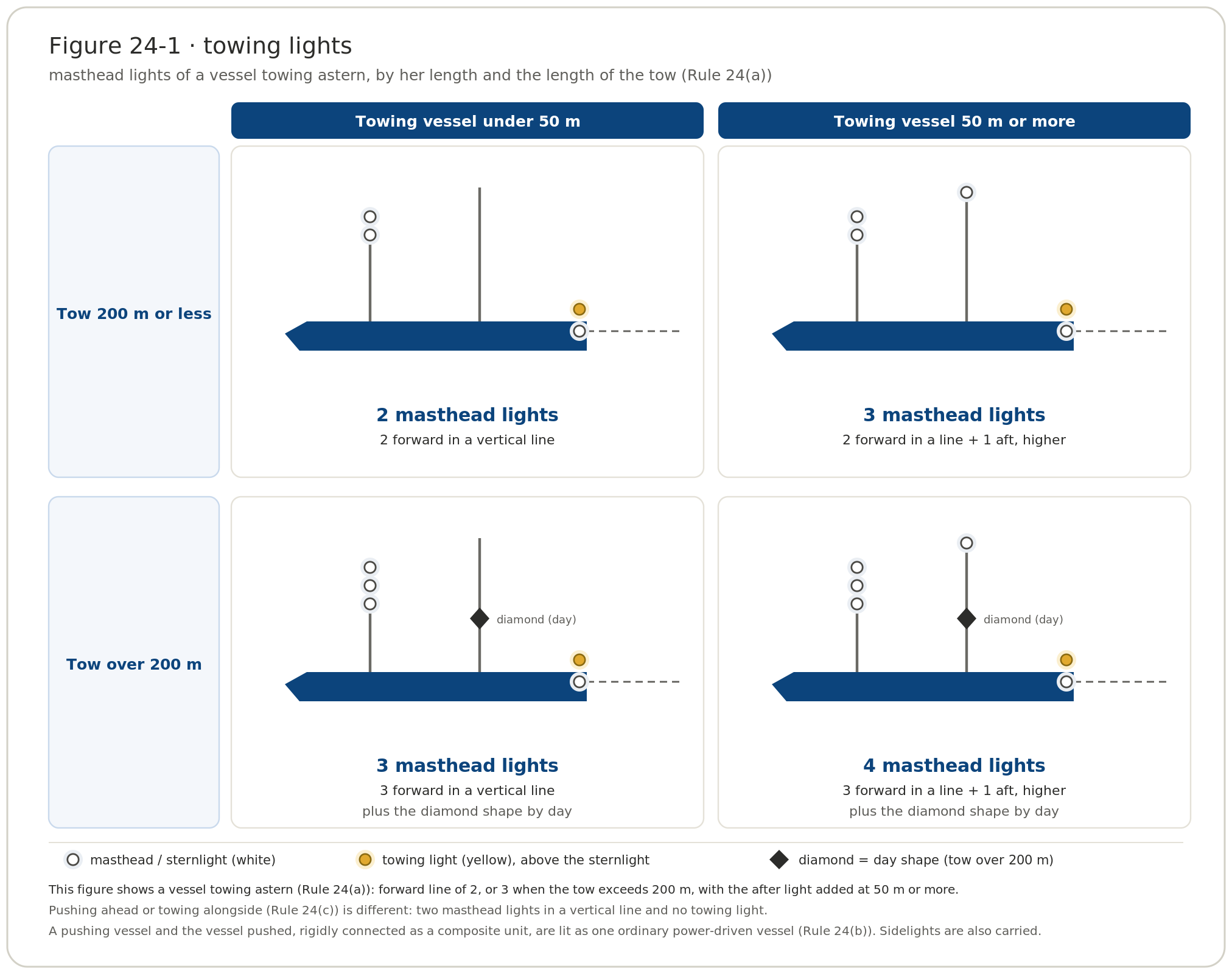
Figure 24-1. Towing lights. The masthead lights of a vessel towing astern, by her length and the length of the tow (Rule 24(a)).
The rule’s text, word for word and annotated: Rule 24 in Appendix B.
Rule 25: Sailing Vessels Underway and Vessels Under Oars · CONCISE
A sailing vessel shows sidelights and a sternlight, with the option of the two all-round red-over-green at the masthead. A vessel under oars may show the sailing lights or simply have a torch ready. The trap is at 25(e): a sailing vessel also using her engine is a power-driven vessel (Rule 3(c)) and must show power-driven lights, and by day must exhibit a cone, apex down. See: Ch 7 (motor-sailer is power-driven).
The rule’s text, word for word and annotated: Rule 25 in Appendix B.
Rule 26: Fishing Vessels · CONCISE
A trawler shows all-round green-over-white; a vessel fishing other than trawling shows all-round red-over-white, with gear signals when it extends. A vessel using trolling lines does not restrict her manoeuvrability and so is not “engaged in fishing” (Rule 3(d)); she shows power-driven or sailing lights as the case may be. See: Ch 7 (fishing only if the gear restricts manoeuvrability).
The rule’s text, word for word and annotated: Rule 26 in Appendix B.
Rule 27: Vessels Not Under Command or Restricted in Their Ability to Manoeuvre · CONCISE
Two all-round red lights in a vertical line mean not under command: I cannot get out of your way, stay clear. Red-white-red means restricted in her ability to manoeuvre: my work restricts me, give me room. A vessel at dredging or underwater work adds two reds on the obstructed side and two greens on the clear side, telling others which side is safe to pass. See: Ch 7 (NUC vs RAM), Rule 18 (their priority).
The rule’s text, word for word and annotated: Rule 27 in Appendix B.
Rule 28: Vessels Constrained by Their Draught · CONCISE
Three all-round red lights in a vertical line, or a cylinder by day. The signal says she cannot deviate because the water itself constrains her, so give her a wide berth, but recall from Chapter 7 that she remains a power-driven vessel and an ordinary crossing can still develop. See: Ch 7 (CBD is a power-driven vessel), Rule 18(d) (not-impede).
The rule’s text, word for word and annotated: Rule 28 in Appendix B.
Rule 29: Pilot Vessels · CONCISE
A vessel on pilotage duty shows all-round white-over-red (“white over red, pilot ahead”), plus the normal underway or anchor lights. Off duty she shows none of this. See: Rule 30 (anchor lights).
The rule’s text, word for word and annotated: Rule 29 in Appendix B.
Rule 30: Anchored Vessels and Vessels Aground · CONCISE
An anchored vessel shows all-round white anchor lights (one, or forward-and-aft on vessels of 50 metres or more) and a ball by day; aground, she adds two all-round reds and three balls. The forward-and-aft arrangement indicates heading and rough length. An anchored vessel’s status matters in the encounter Rules: she is no longer underway, and others manoeuvre around her. See: Ch 7 (underway vs at anchor), Rule 35 (anchor/aground sound signals).
The rule’s text, word for word and annotated: Rule 30 in Appendix B.
Rule 31: Seaplanes · CONCISE
A seaplane shows lights as close as practicable to those prescribed, since her configuration may make exact compliance impossible (the same principle as Rule 1(e)). She is a vessel (Rule 3(a)) and keeps well clear of all vessels. See: Ch 3 (Rule 1(e)), Ch 7 (seaplane defined).
The rule’s text, word for word and annotated: Rule 31 in Appendix B.
Part D: Sound and Light Signals
Rule 32: Definitions (Sound Signals) · CONCISE
Short blast: about one second. Prolonged blast: four to six seconds. Every signal in Part D is built from these two, so the distinction is the key to reading all of them. See: Rules 34–35.
The rule’s text, word for word and annotated: Rule 32 in Appendix B.
Rule 33: Equipment for Sound Signals · CONCISE
Vessels carry a whistle, and vessels of 12 metres or more a bell, with a gong as well on vessels of 100 metres or more. On a large anchored vessel the bell is sounded forward and the gong aft, giving an approaching vessel a sense of her orientation in fog. See: Rule 35 (anchor signals).
The rule’s text, word for word and annotated: Rule 33 in Appendix B.
Rule 34: Manoeuvring and Warning Signals · FULL
In sight of one another, a power-driven vessel signals her helm action: one short blast, “I am altering to starboard”; two short, “I am altering to port”; three short, “I am operating astern propulsion” (34(a)). The doubt signal of 34(d) is five or more short, rapid blasts, “I do not understand your intentions” or “I doubt you are taking sufficient action.” In a narrow channel, the overtaking signals of 34(c): two prolonged plus one short to overtake on the starboard side, two prolonged plus two short for the port side, answered by prolonged-short-prolonged-short for agreement. One prolonged is the blind-bend signal (34(e)). Light signals may supplement the whistle, one flash per short blast.
PRACTICAL NOTE: the five-blast signal
Five short rapid blasts are the main signal the stand-on vessel has when the give-way vessel seems not to be acting. The signal does two things at once: it expresses doubt and it warns. If nothing follows from the give-way vessel, the stand-on vessel is at the Rule 17(a)(ii) threshold and should be preparing to act (Chapter 8).
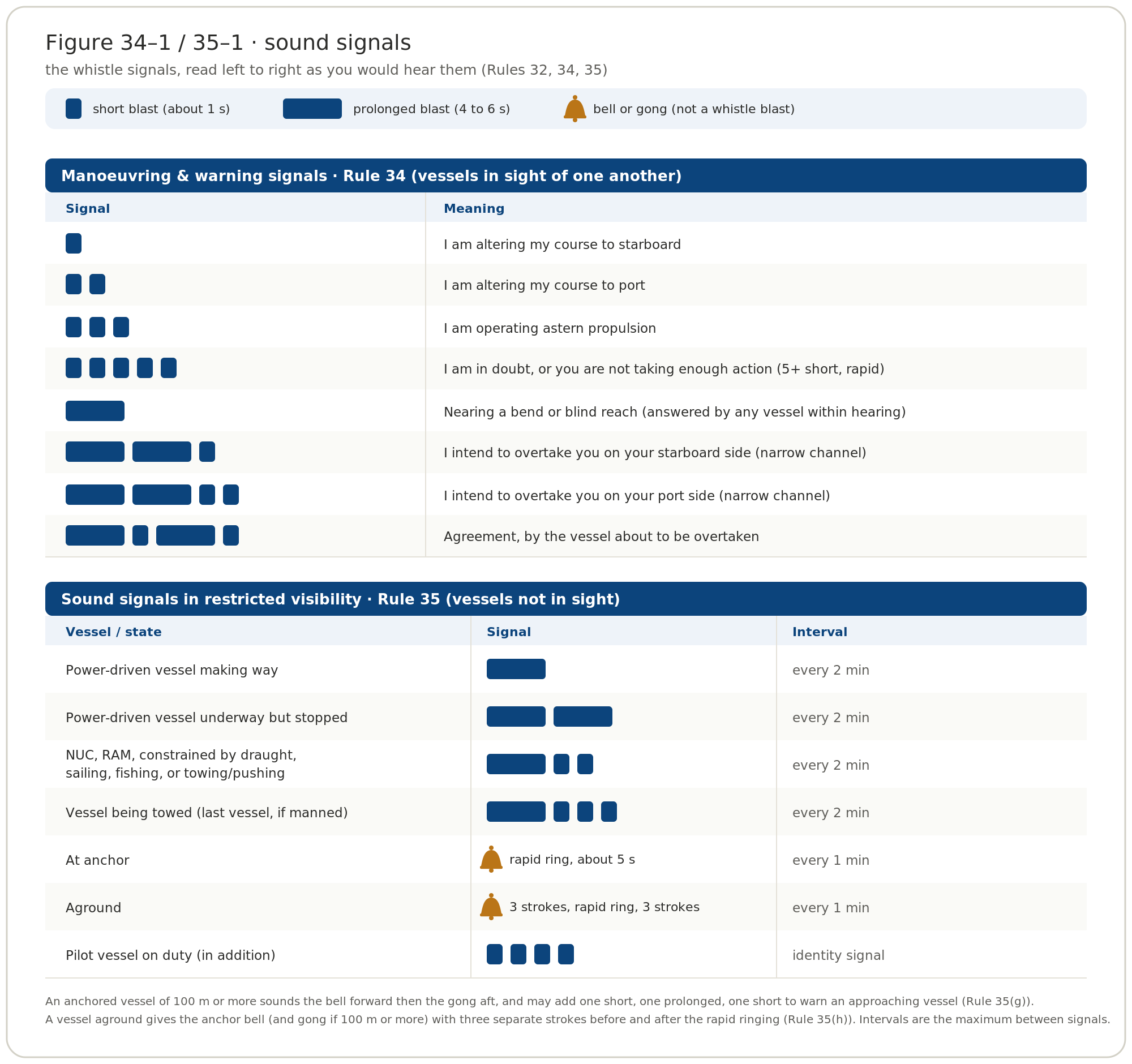
Figure 34-1. Sound signals. The whistle signals of Rules 32, 34 and 35, read left to right as you would hear them: the manoeuvring and warning signals for vessels in sight, and the restricted-visibility signals with their intervals.
Interactions: Rule 34 is read with Rules 8 and 16/17 (the signals announce the action those Rules require), with Rule 9(e) (the narrow-channel overtaking protocol), and with Rule 13 (the vessel being overtaken). See: Ch 8 (the doubt signal and the four stages).
The rule’s text, word for word and annotated: Rule 34 in Appendix B.
Rule 35: Sound Signals in Restricted Visibility · FULL
The fog signals, sounded at the stated intervals. One prolonged blast every two minutes: a power-driven vessel making way. Two prolonged, with a short gap, every two minutes: a power-driven vessel underway but stopped and making no way. One prolonged plus two short: a vessel not under command, restricted in her ability to manoeuvre, constrained by her draught, sailing, fishing, or towing or pushing, the “hampered” group sharing one signal. One prolonged plus three short: a vessel being towed (or the last of the tow, if manned). A rapid bell for five seconds every minute: a vessel at anchor, with the gong aft on large vessels; bell-and-gong with three strokes added: aground.
PRACTICAL NOTE: making way versus stopped
The difference between one prolonged blast and two is the difference between a target moving through the water and one stopped in it. A vessel giving two prolonged blasts will hold her position relative to the water but may still be set by the current, which changes how you should read the developing situation (Chapter 7, underway vs making way).
The fog signals, their intervals, and the making-way / stopped / hampered / towed / anchored / aground logic are set out in Figure 34-1 above.
Interactions: Rule 35 is the restricted-visibility counterpart of the Part C lights (the same vessel states, signalled by ear instead of eye), and is read with Rule 19 (conduct on hearing a fog signal) and Rule 7 (a fog signal forward of the beam bears on risk of collision). See: Ch 5 (Parts C/D as the input side), Ch 7 (underway vs making way).
The rule’s text, word for word and annotated: Rule 35 in Appendix B.
Rule 36: Signals to Attract Attention · CONCISE
A vessel may use any light or sound signal to draw attention, or direct a searchlight at a danger, provided it cannot be mistaken for a signal with a prescribed meaning. A permission, not an obligation. See: Rule 34 (prescribed signals it must not clash with).
The rule’s text, word for word and annotated: Rule 36 in Appendix B.
Rule 37: Distress Signals · CONCISE
The distress signals are those listed in Annex IV, to be used only to signal actual distress, and they trigger search-and-rescue obligations on those who see them. A false distress signal is a serious offence under national law. See: back matter (Annex IV), Ch 2 (the GMDSS-era distress amendments).
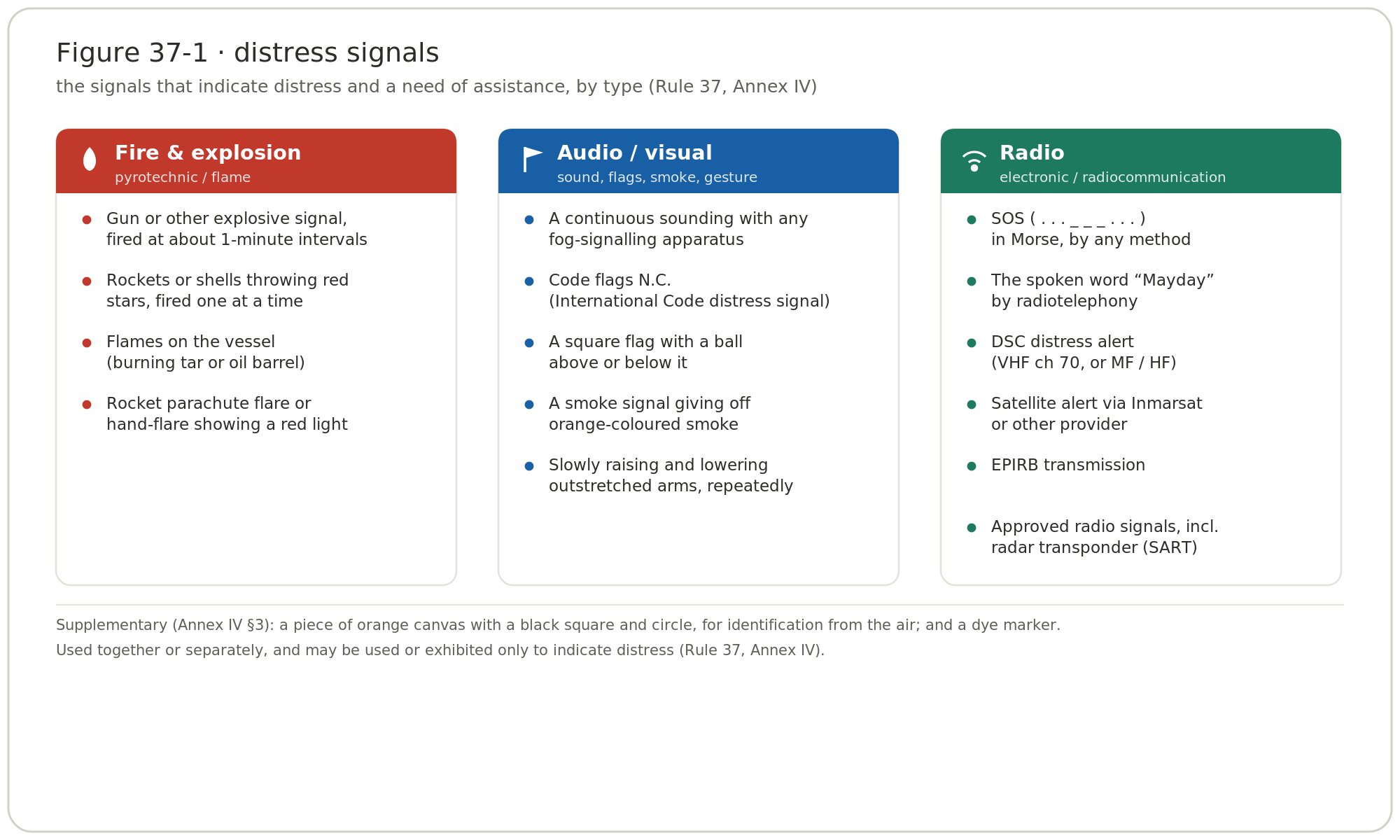
Figure 37-1. Distress signals. The signals that indicate distress and a need of assistance, by type (Rule 37, Annex IV).
The rule’s text, word for word and annotated: Rule 37 in Appendix B.